Strengthening Trust Through Zero-Trust Architecture in Financial Services
Financial services organizations are adopting AI at an unprecedented pace. From fraud detection and credit scoring to personalized experiences and automated compliance, AI is now central to how banks, insurers, and fintechs operate.
This shift is happening at scale. More than 75% of financial institutions already use AI in at least one core function, particularly in fraud prevention, customer experience, and risk analytics. While this accelerates innovation, it also expands the attack surface introducing new APIs, automated decision engines, cloud workloads, and machine identities that traditional perimeter-based security can no longer protect.
This is where Zero Trust Architecture becomes essential.
As AI systems access sensitive data, trigger transactions, and operate autonomously across ecosystems, financial institutions can no longer assume internal trust. Zero Trust replaces that assumption with continuous verification ensuring every user, application, API, and device is authenticated and authorized in real time.
In an AI-driven financial ecosystem, Zero Trust is no longer just a security model. It is a foundation for trust, compliance, and long-term resilience.

Why Financial Services Need Zero Trust Now
A Changing Technology and Trust Model
AI, cloud platforms, APIs, and digital-first experiences have transformed financial services. Traditional perimeter-based security, built on implicit trust, can no longer protect distributed and highly automated environments. Zero Trust has become essential for maintaining security, compliance, and competitiveness.
Identity Is the New Attack Surface
Most cyberattacks now target identities rather than networks. Stolen credentials, account takeovers, and privilege misuse are increasing, alongside the rise of non-human identities such as AI services, APIs, and automation bots. Zero Trust addresses this by continuously verifying every identity before granting access.
AI and Automation Increase Exposure
AI-powered systems handle sensitive data and operate at scale, amplifying the impact of misconfigurations or breaches. Zero Trust enforces strict access controls and monitoring for both human users and automated processes, reducing risk while enabling innovation.
The Perimeter No Longer Exists
Hybrid, multi-cloud, and API-led ecosystems have made the traditional network boundary irrelevant. Zero Trust shifts security closer to users, applications, and data, regardless of where they reside.
Compliance and Customer Trust at Stake
Regulations demand granular control and auditability, while customers expect uninterrupted, secure services. Zero Trust supports both by enforcing least-privilege access, improving visibility, and containing incidents before they affect trust or reputation.
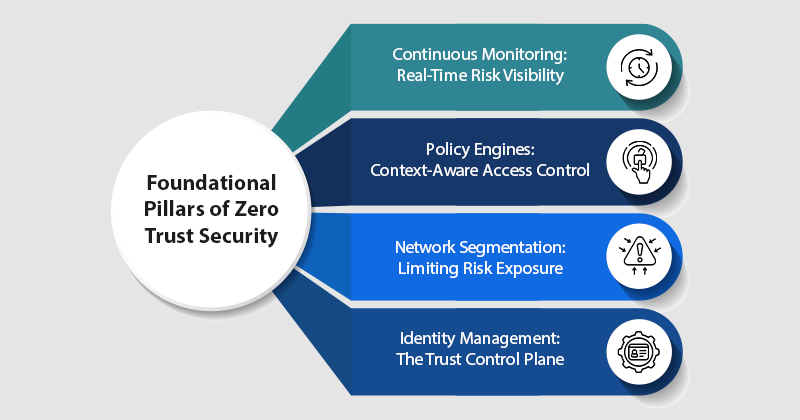
Foundational Pillars of Zero Trust Security
Zero Trust Architecture replaces static, perimeter-based security models with a dynamic, intelligence-driven approach that continuously evaluates risk. Rather than assuming trust based on location or network presence, Zero Trust enforces verification at every interaction. Four foundational pillars work together to enable this model and ensure secure, compliant financial operations in an AI-driven ecosystem.
Continuous Monitoring: Real-Time Risk Visibility
In financial services, risk changes by the minute. Continuous monitoring provides real-time insight into user behavior, device health, application activity, and data access. By continuously evaluating these signals together, institutions can detect unusual logins, suspicious transactions, or abnormal API behavior early and act before threats escalate.
Policy Engines: Context-Aware Access Control
Policy engines ensure access decisions are intelligent, consistent, and auditable. Instead of static permissions, they evaluate every request against role, context, data sensitivity, and regulatory rules. This allows financial institutions to enforce precise access while maintaining clear visibility and traceability for compliance and governance.
Network Segmentation: Limiting Risk Exposure
Zero Trust eliminates broad network access by breaking environments into controlled segments. Users and systems gain access only to the applications they need, nothing more. This approach reduces attack surfaces and ensures that even if credentials are compromised, critical systems such as payment platforms and customer data remain protected.
Identity Management: The Trust Control Plane
Identity sits at the center of Zero Trust. As cloud, APIs, AI services, and automation expand, trust is defined by identity rather than location. Continuous authentication, adaptive authorization, and strict lifecycle management ensure both human and machine identities operate with least-privilege access at all times.
Zero Trust Base 3.1: Laying the Right Foundation
Before scaling Zero Trust across the organization, financial institutions need to get the basics right. This initial stage, often referred to as Zero Trust Base 3.1, is about moving away from implicit trust and putting simple, effective controls in place.
At this point, identity becomes the starting point for all access decisions. Multi-factor authentication is enforced for users and privileged accounts, and key applications are brought under identity-based access. Basic visibility and logging help teams understand who is accessing systems and highlight areas of risk.
This foundation helps reduce immediate exposure, supports regulatory expectations, and creates the confidence to move forward. With Base 3.1 in place, financial institutions are better prepared to roll out Zero Trust in phases securely and without disrupting business operations.

How Espire Helps Financial Services Implement Zero Trust
Espire helps financial institutions move from fragmented security controls to a clear, practical Zero Trust strategy that aligns with regulatory demands, complex legacy environments, and modern AI-driven operations. Our focus is on enabling Zero Trust without disrupting core business protecting critical assets while maintaining performance, compliance, and trust.
Once this foundation is established, Espire follows a proven, phased roadmap to implement Zero Trust in a structured and scalable way.
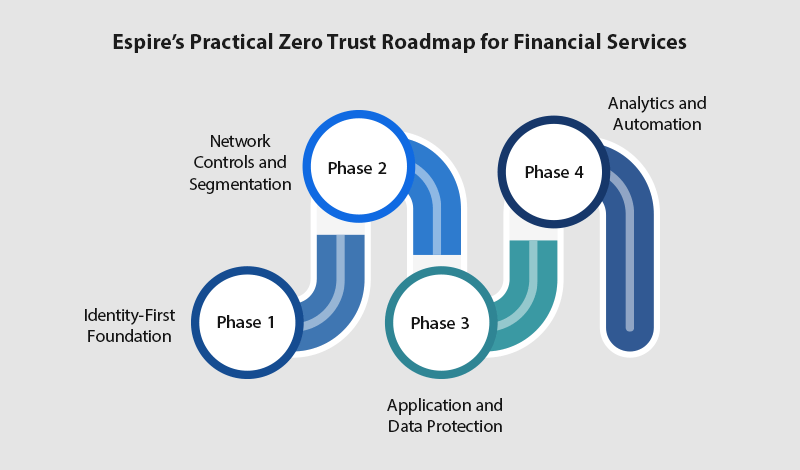
Espire’s Practical Zero Trust Roadmap for Financial Services
Zero Trust is not a one-time deployment it is a transformation journey. For financial services organizations where uptime, regulatory compliance, and customer confidence are non-negotiable, Espire adopts a phased approach that modernizes security while keeping operations stable.
Phase 1: Identity-First Foundation
Espire begins by establishing identity as the control plane. We help institutions inventory and govern all identities employees, contractors, applications, APIs, bots, devices, and AI workloads to gain clarity on access and exposure.
Strong authentication, including MFA and biometrics for high-risk scenarios, is implemented alongside role-based access policies aligned with business responsibilities and regulatory requirements. This immediately reduces identity-driven risk and creates a secure access baseline.
Phase 2: Network Controls and Segmentation
With identities secured, Espire focuses on reducing attack surface. Flat networks are replaced with segmented architectures that isolate critical systems such as payment processing, core banking, and risk platforms.
Through network access controls and Zero Trust Network Access (ZTNA), Espire enables secure, application-level connectivity instead of broad VPN access supporting hybrid work while limiting lateral movement during security incidents.
Phase 3: Application and Data Protection
Espire then secures applications, data, and integrations. Application security gateways inspect and control traffic, while data loss prevention ensures sensitive financial data is accessed and shared only with proper authorization.
API security becomes a key priority at this stage, enabling secure open banking, embedded finance, and partner integrations without increasing exposure or complexity.
Phase 4: Analytics and Automation
In the final phase, Espire makes Zero Trust adaptive and intelligent. Behavioural analytics help detect abnormal access patterns that may indicate fraud, insider threats, or compromised accounts.
Automated response mechanisms allow faster containment revoking access, isolating systems, or triggering investigations while continuous policy tuning ensures Zero Trust evolves with business growth and regulatory change.
Conclusion
As financial services adopt AI, cloud platforms, and open ecosystems, trust must be embedded into every digital interaction. Zero Trust Architecture enables this shift by ensuring continuous verification, least-privilege access, and stronger control over identities, applications, and data.
By aligning security with business and regulatory needs, Espire helps financial institutions implement Zero Trust as a foundation for resilience, compliance, and seamless customer and employee experiences.
Ready to build trust by design?
Connect with our experts today to implement a Zero Trust strategy tailored for modern financial services.