Data Governance and Compliance in an AI World: A Survival Guide for BFS Leaders
The Banking & Financial Services (BFS) industry is racing toward an AI-driven future—hyper-personalized experiences, real-time decisioning, automated underwriting, and intelligent fraud prevention are no longer aspirational. They’re becoming the default.
But there’s a flip side: more AI means more data, and more data means greater regulatory scrutiny. As leaders push for accelerated innovation with generative AI, predictive analytics, and machine-led automation, regulators across the globe are tightening their frameworks—GDPR, DORA, FCA guidelines, PRA expectations, PCI DSS, and emerging AI-specific regulations.
This creates a critical dilemma for every BFS leader.
So, how do you innovate at scale without stumbling into a minefield of compliance, privacy, and operational risk?
This guide breaks down the core challenges and directs you toward a secure, resilient, and regulatory-compliant AI-first future powered by Espire’s proven experience in architecting secure data ecosystems.

The New AI Reality: Why Governance Matters More Than Ever
Artificial intelligence has quickly evolved from a promising innovation to an operational backbone for the Banking & Financial Services (BFS) industry. From credit decisioning to fraud detection, customer experience to back-office automation, AI now touches nearly every workflow. And with the rise of generative AI, the volume, variety, and velocity of data feeding these systems has grown exponentially.
But this new reality comes with a fundamental truth:
AI amplifies both the opportunities and the risks that are embedded in your data.
This is precisely why data governance has become a leadership-level priority, not just a technical responsibility.
AI Is Now the Operational Core of BFS
AI has shifted from being a niche innovation to becoming fundamental to BFS operations. From credit decisions and fraud scoring to KYC automation and predictive customer analytics, AI models are consuming more data than ever before. As the volume and sensitivity of these datasets increase, the need for strong governance becomes foundational and not optional.
AI Magnifies Both Opportunity and Risk
AI drives efficiency and intelligence, but it also amplifies the weaknesses within an organization’s data environment. Sensitive financial histories, transaction records, and behavioral insights can easily be mishandled if governance is weak. Poorly controlled datasets can expose organizations to privacy violations, biased outcomes, and non-compliant automated decisions.
Regulators Are Demanding More Accountability Than Ever
Compliance frameworks such as GDPR, DORA, FCA guidelines, PRA model risk policies, PCI DSS, and the forthcoming EU AI Act are raising expectations. Regulators now require transparent audit trails, clear explanations for AI-driven decisions, and resilient architectures capable of withstanding operational disruptions. The days of reactive compliance are over and proactive governance is the only path forward.
Governance Is Essential for Ethical, Explainable, and Fair AI
AI’s outputs are only as trustworthy as the data behind them. Inconsistencies, duplication, outdated values, or hidden biases can propagate through models and create harmful outcomes, particularly in underwriting, credit scoring, AML screening, and fraud analytics. Governance ensures accuracy, fairness, and explainability, meeting both regulatory expectations and ethical standards.

The Compliance Balancing Act: Key Challenges for BFS Leaders
As AI becomes woven into the core of banking and financial services, leaders find themselves at a crossroads. On one side lies the promise of innovation—smarter decisions, real-time automation, hyper-personalized experiences, and efficiency at scale. On the other side is an increasingly complex compliance landscape shaped by GDPR, DORA, FCA, PRA, PCI DSS, AML/CFT mandates, and new AI-focused regulations emerging worldwide.
The challenge isn’t just meeting these requirements—it’s innovating confidently while maintaining compliance, security, and operational resilience. Below are the core obstacles BFS leaders must navigate.
Legacy Constraints vs. AI Acceleration
Most BFS institutions are running AI initiatives far ahead of their existing governance capabilities. Innovation is moving quickly - model pilots, new analytics workflows, and external AI tools are being adopted at a rapid pace. But governance, policy management, and data oversight have not evolved at the same speed.
This creates a situation where:
- AI projects start without complete visibility into data quality
- Models are developed without clear lineage or documentation
- Data is accessed across silos without proper authorization or monitoring
As a result, organizations inadvertently expose themselves to compliance and ethical risks long before AI systems reach production.
A Complex and Overlapping Regulatory Landscape
BFS leaders must navigate a regulatory ecosystem that grows more intricate each year. GDPR demands strong privacy, consent, and processing controls. FCA and PRA directives require explainability and model risk governance. DORA introduces rigorous expectations for ICT resilience. PCI DSS covers payment data security. AML/CFT laws enforce near-real-time monitoring and reporting.
The challenge stems not from the existence of these frameworks—but from the overlap between them:
- Each mandates its own set of controls
- Each requires specific reporting and audit readiness
- Each demands visibility across systems that don’t naturally integrate
For many organisations, compliance becomes a manual and reactive exercise, increasing the risk of non-compliance during audits or regulatory reviews.
Black-Box AI Models and the Explainability Gap
Regulators increasingly expect transparency around AI decisions. Whether approving loans, prioritizing cases, triggering fraud alerts, or calculating risk, financial institutions must now justify not only the outcome but also the logic behind AI-driven decisions.
Many modern AI techniques - with deep learning and GenAI at the forefront—operate like black boxes, making them inherently difficult to explain. Without clear insight into how models work and what data influences them, organizations risk:
- Failing regulatory audits
- Exposing hidden bias in critical workflows
- Losing customer trust during disputes
Explainability and model governance are now essential - not optional.
Inconsistent Controls Across Hybrid and Multi-Cloud Environments
As institutions embrace multi-cloud strategies, they face governance fragmentation. Azure, AWS, GCP, Snowflake, Databricks, and various SaaS tools all provide different security models, access controls, and governance layers
This creates blind spots such as:
- Policies not applied uniformly across platforms
- Data moving across borders without adequate oversight
- Variations in encryption, masking, and retention standards
Without centralized governance and monitoring, inconsistencies become compliance vulnerabilities.
Lack of Unified Ownership for Data, AI, and Governance
Governance fails when ownership is unclear. In many BFS organizations:
- IT manages infrastructure
- Data teams manage pipelines
- Risk and compliance manage controls
- Business units manage domain logic
This fragmented ownership leads to duplicated policies, inconsistent data usage, and unclear accountability when issues occur. AI adoption demands a unified governance approach with clearly defined roles, responsibilities, and escalation paths.
The Survival Strategy: Building Strong Data Governance for an AI-First BFS Enterprise
As BFS organizations accelerate their AI adoption, the path forward must be anchored in trust, transparency, and compliance. AI cannot scale on unstable or ungoverned foundations. To unlock its full potential, leaders must intentionally design a governance strategy that balances innovation with regulatory expectations—while ensuring data remains secure, ethical, and high quality across the enterprise.
Below is a comprehensive strategy that BFS leaders can adopt to govern data and AI confidently.
- Unify Governance Frameworks: Establish a single, enterprise-wide data and AI governance model to ensure consistent policies, compliance and audit readiness across all systems and teams.
- Adopt Compliant-by-Design Architectures: Build modern, AI-ready data platforms such as governed lakehouses and MLOps pipelines to enable secure, scalable and compliant innovation.
- Ensure End-to-End Data Lineage: Maintain full visibility and traceability of data across AI systems to meet GDPR, DORA, FCA and emerging AI regulatory expectations.
- Embed Data Privacy and Access Controls: Enforce ethical data usage through encryption, masking, tokenization and role-based access to protect sensitive information.
- Strengthen Responsible AI Governance: Implement transparent, fair and monitored AI models with documentation, versioning and drift detection to mitigate bias and regulatory risk.
- Enhance Security and Resilience: Continuously monitor threats, enforce identity controls and conduct resilience testing to safeguard AI systems and meet DORA standards.
- Foster Data Literacy and Accountability: Build a culture of shared data ownership across business, IT and compliance for responsible and transparent AI practices.
- Automate Governance at Scale: Use automation for lineage mapping, policy enforcement, and monitoring to accelerate compliance and reduce manual errors.
- Espire Advantage: Empowering BFS enterprises with secure, compliant and AI-ready transformation solutions.
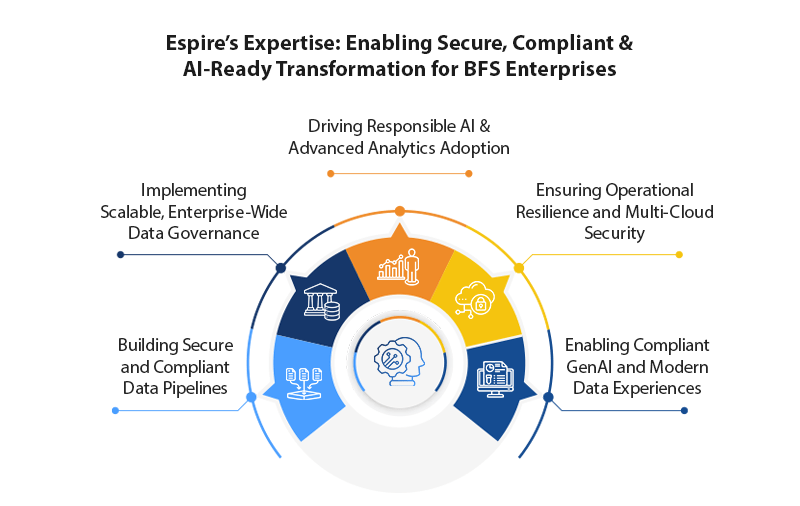
Espire’s Expertise: Enabling Secure, Compliant & AI-Ready Transformation for BFS Enterprises
Building Secure and Compliant Data Pipelines
- Espire designs end-to-end, secure data pipelines that modernize BFS data foundations while ensuring full alignment with global regulatory frameworks.
- Our architectures protect data at every stage—whether sourced from core banking systems, multi-cloud platforms, or third-party fintech tools.
- We embed strong encryption, privacy controls, access governance, and data minimization to safeguard sensitive financial information.
- Compliance is integrated into every workflow, supporting strict mandates including GDPR, DORA, PCI DSS, FCA, PRA, and other industry-specific regulations.
Implementing Scalable, Enterprise-Wide Data Governance
- Espire enables BFS institutions to build scalable and adaptable governance frameworks that evolve with expanding data ecosystems.
- We bring proven expertise in metadata management, automated classification, PII masking, and lineage mapping to create transparency across data flows.
- Governance policies are embedded into daily operations, ensuring efficient data usage without compromising regulatory standards.
- Our approach transforms governance into a strategic advantage, rather than a compliance burden.
Driving Responsible AI & Advanced Analytics Adoption
- Espire incorporates responsible AI practices into every stage of the model lifecycle—ensuring transparency, fairness, and accountability.
- We support BFS clients with capabilities such as bias detection, model documentation, drift monitoring, explainability, and audit readiness.
- Whether it’s credit scoring, fraud detection, underwriting automation, or predictive analytics, we ensure AI solutions remain compliant and ethically sound.
Ensuring Operational Resilience and Multi-Cloud Security
- We design infrastructures that meet DORA’s ICT resilience requirements, ensuring BFS operations remain stable under pressure.
- Espire delivers continuous monitoring, identity governance, vulnerability scanning, and cloud posture management to protect distributed environments.
- Our multi-cloud security frameworks reduce risk across Azure, AWS, GCP, Databricks, Snowflake, and other platforms.
Enabling Compliant GenAI and Modern Data Experiences
- Espire helps BFS institutions adopt GenAI solutions responsibly, ensuring models use only validated and compliant data.
- We design GenAI workflows with full traceability, usage controls, and strong privacy protections to prevent regulatory violations.
- From AI copilots and IDP solutions to customer intelligence platforms, we embed compliance into every GenAI implementation.
The Espire Factor
- 20+ years in digital transformation across global BFS organizations
- Deep specializations in data governance, data engineering, data insights, data science, machine learning, AI, and multi-cloud security
- Proven accelerators for Enhancing Data maturity, Governed Data Lakehouse, API Modernisation, Agentic AI, and more
- Strong partnerships with Microsoft, Databricks, Snowflake, MuleSoft, and AWS
- Delivery models built around agility, compliance, and global scalability
Espire brings the technical depth, regulatory understanding, and real-world BFS expertise required to help institutions build AI-driven, secure, and compliant digital ecosystems.
Conclusion: Lead With Trust, Innovate with Confidence
AI is transforming BFS at speed—but only organizations with strong data governance will innovate confidently and stay ahead. By embedding compliance, transparency, and security into every layer of your data ecosystem, you create the foundation for trusted, scalable, and responsible AI.
Ready to strengthen your governance and unlock AI with confidence?
Connect with Espire’s experts and build a secure, compliant, and future-ready BFS ecosystem today.