Building the Intelligent Supply Chain: Real-Time Analytics from Warehouse to Delivery
The logistics industry has undergone a fundamental transformation. What was once a function focused purely on moving goods from point A to point B has evolved into a highly data-driven, technology-powered ecosystem that connects warehouses, suppliers, fleets, partners, and customers in real time.
Today’s logistics leaders are expected to deliver speed, accuracy, transparency, and resilience, all while managing volatile demand, global disruptions, labor shortages, and rising operational costs. This shift has accelerated digital transformation across the supply chain. According to McKinsey, logistics players that adopt advanced analytics and AI can reduce forecasting errors by up to 50% and cut inventory costs by 20–30%.
At the heart of this evolution lies the intelligent supply chain, one that uses real-time analytics and AI to continuously sense, analyze, and respond across warehouse operations and last-mile delivery.
The Arrival of AI in Logistics and Its Impact on the Supply Chain
Artificial Intelligence has moved logistics from reactive execution to proactive orchestration. Traditional supply chains relied heavily on historical reports, manual planning, and siloed systems. AI has changed that by enabling continuous learning from live operational data, external signals, and historical trends.
In supply chain and warehouse management, AI helps businesses predict demand more accurately, optimize inventory placement, automate repetitive tasks, and respond instantly to disruptions. Machine learning models analyze patterns across sales, weather, traffic, supplier performance, and customer behavior to drive smarter decisions often in real time.
As a result, warehouses are becoming intelligent fulfillment hubs, fleets are becoming adaptive networks, and supply chains are shifting from linear processes to connected, self-optimizing systems.
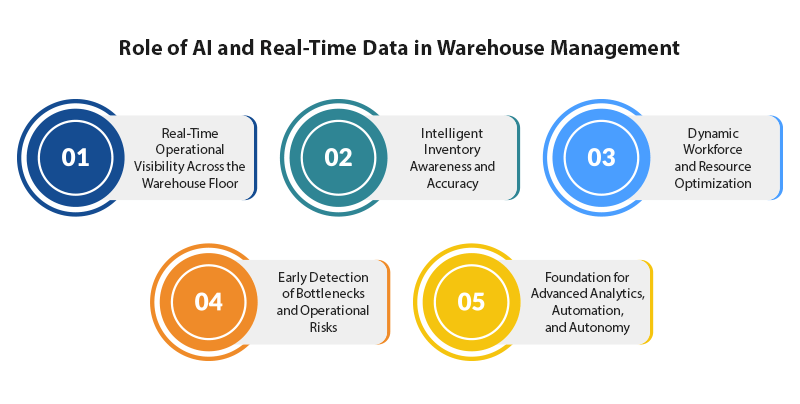
Role of AI and Real-Time Data in Warehouse Management
Real-Time Operational Visibility Across the Warehouse Floor
AI-enabled real-time data provides continuous visibility into every aspect of warehouse operations from inventory movement and order status to workforce activity and asset utilization. Data captured through IoT sensors, RFID tags, cameras, and WMS platforms is updated instantly, eliminating latency and blind spots common in traditional systems. This live visibility allows warehouse managers to understand what is happening at any given moment, quickly identify deviations from planned operations, and respond before small issues escalate into operational disruptions.
Intelligent Inventory Awareness and Accuracy
AI uses real-time inventory data to maintain a highly accurate view of stock levels, locations, and movement patterns. Instead of relying on periodic cycle counts or manual reconciliation, AI continuously validates inventory positions, detects mismatches, and highlights potential shrinkage or misplacements. This intelligence ensures that inventory records reflect physical reality, reduces picking errors, and supports faster order fulfillment. As a result, warehouses can operate with higher accuracy, reduced safety stock, and improved confidence in inventory availability.
Dynamic Workforce and Resource Optimization
Real-time data combined with AI enables dynamic optimization of labor and warehouse resources. AI analyzes live workloads, order volumes, picking complexity, and workforce availability to recommend or trigger task reallocation. If congestion builds in one zone or demand spikes unexpectedly, AI highlights the imbalance and supports rapid redistribution of labor or equipment. This allows warehouses to maximize productivity, reduce idle time, and maintain consistent throughput even during peak demand periods or operational disruptions.
Early Detection of Bottlenecks and Operational Risks
AI continuously monitors operational signals to detect early signs of inefficiency or risk. This includes identifying growing queues at packing stations, delays in picking routes, underperforming equipment, or abnormal dwell times for inventory. By recognizing these issues in real time, warehouse teams can take corrective action before SLAs are impacted. This proactive awareness shifts warehouse management from reactive firefighting to preventative control, reducing downtime and improving overall operational stability.
Foundation for Advanced Analytics, Automation, and Autonomy
The role of AI and real-time data in warehouse management ultimately extends beyond visibility it creates the foundation for advanced capabilities. Accurate, real-time intelligence feeds descriptive and predictive analytics, enables effective automation, and supports the deployment of autonomous and agentic systems. Without this foundational layer, automation becomes rigid and analytics become outdated. With it, warehouses gain the agility, responsiveness, and scalability required to evolve into fully intelligent, adaptive fulfillment environments.
Why the Logistics Industry Needs Intelligent Supply Chain Management
Logistics operations today operate under constant pressure from fluctuating demand and global supply disruptions to tighter delivery windows and rising customer expectations. Traditional systems lack the speed and intelligence needed to manage this complexity.
Intelligent supply chain management enables logistics businesses to move from reactive firefighting to proactive optimization. It improves end-to-end visibility, enhances decision-making, reduces operational risks, and creates the agility required to scale efficiently in unpredictable environments.
Most importantly, it aligns warehouse operations, transportation, and last-mile delivery into a single, connected ecosystem ensuring consistency, resilience, and customer satisfaction.
How AI and Real-Time Analytics Help Build an Intelligent Supply Chain Infrastructure
AI and real-time analytics act as the digital backbone of an intelligent supply chain. They unify data from warehouses, transportation systems, IoT devices, ERP platforms, and external sources into a single operational view.
Real-time analytics enables instant insights into inventory levels, shipment status, delays, and capacity constraints. AI models then use these insights to recommend or automatically execute actions such as rerouting shipments, adjusting warehouse workloads, or rebalancing inventory across locations.
This combination allows logistics businesses to anticipate disruptions, optimize resources dynamically, improve service levels, and make faster, data-backed decisions across the entire supply chain lifecycle.

How Espire’s Services Help Logistics Businesses Deliver Seamless Results
Building a Unified Intelligence Layer Across the Supply Chain
A multi-location logistics provider struggled with fragmented visibility across warehouses and transportation partners, with each system reporting different versions of inventory and order status. Espire unified data from WMS, TMS, ERP, and IoT feeds into a single intelligence layer, ensuring all stakeholders operated on the same real-time information. As a result, inventory accuracy improved significantly, planning cycles shortened, and delays caused by data inconsistencies were eliminated. Unified intelligence became the foundation for faster, coordinated decision-making across the supply chain.
Applying Descriptive Analytics for Operational Transparency and Control
In a high-volume fulfillment warehouse, managers lacked clarity on why certain orders consistently missed SLAs. Espire implemented descriptive analytics dashboards that provided real-time visibility into picking delays, packing bottlenecks, and labor utilization by zone and shift. These insights revealed that congestion during peak hours - not workforce shortage - was the primary issue. By redesigning workflows and rebalancing labor dynamically, the warehouse reduced order cycle times, improved SLA compliance, and increased throughput without adding headcount.
Enabling Predictive Analytics for Proactive Planning and Resilience
A logistics company supporting seasonal retail demand frequently faced last-minute stockouts and expedited shipping costs. Espire introduced predictive analytics models that combined historical sales data with real-time demand signals and external factors like seasonality and promotions. The system predicted demand spikes weeks in advance, allowing inventory to be redistributed proactively across warehouses. This reduced stockouts, minimized emergency shipments, and improved on-time delivery performance—while lowering overall inventory carrying costs.
Driving AI-Led Automation for Scalable Execution
As order volumes increased, a 3PL provider struggled to scale operations without increasing operational overhead. Espire implemented AI-led automation across order processing, task assignment, exception handling, and system updates. Real-time triggers automatically initiated workflows without human intervention. This significantly reduced manual effort, eliminated processing errors, and enabled the operation to handle higher volumes without linear increases in cost or staffing delivering true operational scalability.
Introducing Agentic AI for Autonomous, Adaptive Operations
During sudden demand surges and transportation delays, a logistics operator relied on manual escalation to reprioritize orders and reallocate resources often reacting too late. Espire deployed Agentic AI systems that continuously monitored demand fluctuations, capacity constraints, and SLA risks. When disruptions occurred, the system autonomously reprioritized high-value orders, reallocated labor, and adjusted fulfillment strategies in real time. This reduced response time from hours to minutes, protected SLA performance, and significantly improved customer satisfaction during peak volatility.
Conclusion
The future of logistics belongs to intelligent supply chains that can think, adapt, and act in real time. From warehouse floors to last-mile delivery, AI and real-time analytics are redefining how goods move, decisions are made, and value is delivered.
By embracing intelligent supply chain management and partnering with experts like Espire logistics businesses can build resilient, agile, and future-ready operations that deliver speed, efficiency, and exceptional customer experiences in an increasingly complex world.
Ready to build an intelligent, AI-powered supply chain?
Discover how real-time analytics, automation, and Agentic AI can transform your warehouse and logistics operations from reactive to resilient. Connect with Espire today to start your journey toward a smarter, faster, and future-ready supply chain.