How to Modernise Legacy Platforms in Insurance and Drive Post-Modernisation AI Adoption
Let’s think of a world where insurance operations run smartly and efficiently, with uninterrupted data flow, AI-enabled decision-making, and cost-effective innovative solutions. This is the goal for insurance companies to deliver seamless customer experience. To achieve this, businesses are focusing on tackling the challenges of siloed legacy systems. Nevertheless, the emergence and adoption of AI have presented both the urgency and opportunity to modernize the legacy systems. However, AI-powered technologies such as predictive analytics and Generative AI, require integrated data and scalable systems to deliver value to the business.
As evident that even adoption of new technologies requires modernizations of legacy systems. Moreover, there are roadblocks that further propel the need of modernisation. Let’s look at some these challenges:
Challenges Propelling the Need of Modernization of Legacy Systems
The insurance industry has long relied on legacy systems that were built decades ago to manage policies, claims, and customer records. While these systems once served their purpose well, they are now proving to be significant roadblocks in a digital-first world. Several challenges are compelling insurers to accelerate modernization initiatives:
Rising Maintenance and Operational Costs
Legacy platforms often require specialized skills for maintenance, skills that are increasingly scarce and expensive. The cost of running outdated infrastructure, including hardware upkeep, license renewals, and manual patching, can consume up to 70–80% of IT budgets, leaving little room for innovation. This makes cost optimization through modernization not just desirable but essential.
Limited Agility and Speed-to-Market
Today’s customers demand quick, seamless experiences, whether buying a policy online, filing a claim through a mobile app, or receiving real-time updates. Legacy systems, with rigid architectures and siloed data, slow down the rollout of new products and services. Insurers find themselves unable to compete with agile, tech-savvy startups offering digital-first solutions.
Inadequate Customer Experience
Customer expectations have shifted from transactional to experiential. Policyholders now expect omnichannel engagement, instant quotes, and personalized offers. Legacy platforms, which lack integration with digital touchpoints and analytics engines, fall short in delivering these experiences, leading to dissatisfaction, churn, and loss of competitive edge.
Data Silos and Poor Analytics Capabilities
Insurers generate and manage massive amounts of structured and unstructured data across claims, underwriting, customer service, and policy administration. In legacy environments, this data is fragmented and difficult to access, preventing insurers from harnessing advanced analytics or AI. As a result, strategic decision-making is often based on outdated or incomplete information.
Security Risks
Older systems are often incompatible with modern security protocols and become vulnerable to cyberattacks. With sensitive financial and personal data at stake, insurers face heightened risk of data breaches, which can have severe financial and reputational consequences.
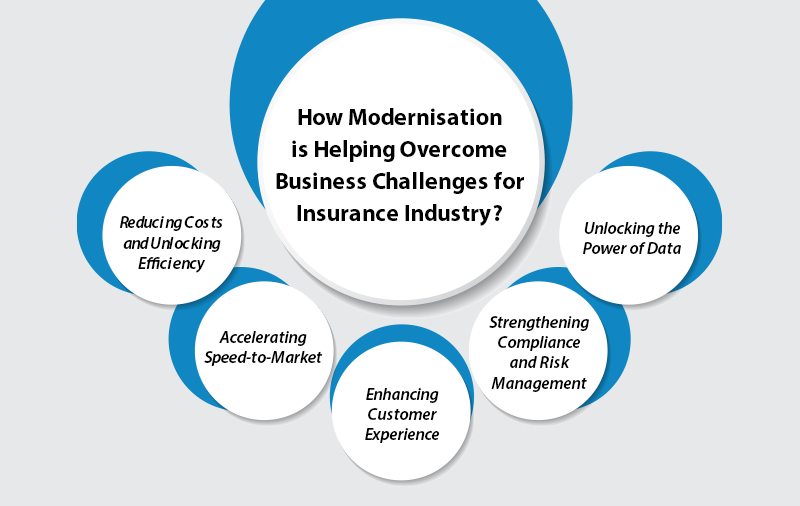
How Modernisation is Helping Overcome These Challenges?
Modernisation is not just about replacing outdated systems with newer ones—it is about fundamentally reimagining the insurance technology landscape to align with today’s digital-first business demands. By adopting cloud-native platforms, API-driven architectures, and intelligent automation, insurers are addressing long-standing challenges and preparing for a more agile, customer-centric future.
Reducing Costs and Unlocking Efficiency
By moving away from legacy infrastructure and adopting cloud-based platforms, insurers significantly cut down on infrastructure and maintenance expenses. Cloud modernisation enables pay-as-you-go scalability, reduces reliance on scarce legacy skillsets, and automates routine upgrades and patches, freeing IT budgets for innovation instead of upkeep.
Accelerating Speed-to-Market
With modern digital platforms, insurers gain the flexibility to quickly design, test, and launch new insurance products and services. Microservices and API-led architectures support faster development cycles and integration with external partners, enabling insurers to react swiftly to changing market demands and regulatory updates.
Enhancing Customer Experience
Modern systems empower insurers to deliver seamless, omnichannel experiences across web, mobile, and agent-assisted platforms. Advanced analytics and AI-enabled personalization engines make it possible to offer real-time quotes, tailored policy recommendations, and faster claims settlement—transforming customer satisfaction into a competitive differentiator.
Strengthening Compliance and Risk Management
Modernised platforms provide automated audit trails, enhanced reporting capabilities, and the ability to quickly adapt to evolving regulatory frameworks such as IFRS 17 or GDPR. This not only reduces compliance risk but also boosts transparency and trust with regulators, customers, and business partners.
Unlocking the Power of Data
Modernisation allows insurers to implement Data Fabric and Data Mesh architectures, enabling unified access to data across departments and geographies. With real-time data pipelines and advanced governance, insurers can tap into actionable insights, predictive modeling, and AI-driven decision-making—something legacy systems couldn’t support.

How Post-Modernisation AI Adoption Can Impact Insurance Business?
Modernisation creates the foundation, but it is artificial intelligence that delivers transformative business impact. Once insurers have moved away from rigid, legacy platforms and adopted modern architectures, they can seamlessly integrate AI across the value chain to drive efficiency, innovation, and customer-centric growth. Post-modernisation AI adoption enables insurers to move from reactive, manual operations to predictive and proactive business models.
Transforming Underwriting Accuracy and Speed
AI-driven underwriting models can process vast datasets, ranging from historical claims to real-time telematics and IoT feeds. This reduces manual assessment times from weeks to minutes while improving risk accuracy. For instance, AI can factor in driving behavior, health data, or geographic risk in real-time, ensuring more precise pricing and reducing adverse selection.
Revolutionizing Claims Management
Claims are the most critical touchpoint in the insurance journey. Post-modernisation AI enables:
- Automated claims intake through AI-powered OCR and NLP for document processing.
- Fraud detection using anomaly detection and predictive models that flag suspicious claims.
- Faster settlements by routing simple claims for straight-through processing while directing complex cases to adjusters.
This improves turnaround time, reduces operational costs, and boosts policyholder trust.
Personalising Customer Engagement
AI allows insurers to move beyond “one-size-fits-all” policies to hyper-personalized experiences. With predictive analytics, insurers can recommend tailored products, suggest preventive services, and engage customers through virtual assistants that provide instant support across digital channels. This improves retention and fosters deeper loyalty.
Driving Operational Excellence with Predictive Insights
AI adoption enables insurers to predict potential churn, forecast claims spikes (e.g., during natural disasters), and anticipate regulatory compliance requirements. By embedding predictive analytics and scenario planning into operations, insurers can reduce risks, optimize resource allocation, and make informed strategic decisions.
Empowering Agents and Employees
AI doesn’t replace the human workforce, it empowers it. Agents can use AI-driven insights to understand customer behavior, identify upsell/cross-sell opportunities, and provide proactive advice. Employees benefit from reduced manual workloads and AI-powered decision support, improving productivity and job satisfaction.
Espire’s AI-Powered Modernisation for Insurance Business
Espire goes beyond conventional modernization, we combine deep insurance domain expertise with cutting-edge AI capabilities to help insurers accelerate digital transformation and unlock tangible business value. Our approach ensures that modernization is not just about replacing legacy systems, but about building an intelligent, AI-enabled ecosystem.
Cloud-Driven Core Modernisation
We help insurers migrate from legacy platforms to cloud-native, scalable infrastructures that lower costs and improve agility. By embedding AI services directly within cloud environments, we enable insurers to leverage real-time analytics, predictive intelligence, and automated system optimization as part of their modernization journey.
AI-Powered Data Fabric and Governance
Espire’s AI-driven data solutions go beyond unifying data silos. With AI-enhanced data fabric, insurers can:
- Detect anomalies in customer and claims data automatically.
- Use AI to cleanse, standardize, and enrich datasets for compliance readiness.
- Enable faster decision-making through predictive and prescriptive insights across underwriting, pricing, and claims.
Intelligent Claims and Fraud Detection
Espire integrates AI-powered OCR, NLP, and machine learning models into claims workflows. This enables insurers to:
- Automate claims intake and verification.
- Identify fraudulent patterns in real-time using anomaly detection.
- Shorten settlement cycles with straight-through AI processing.
AI-Driven Customer Engagement
We help insurers deliver hyper-personalized customer experiences through:
- GenAI-powered chatbots and voice bots for 24/7 support.
- Predictive engagement models that recommend tailored policies based on lifestyle and behavior.
- Sentiment analysis to refine service strategies and improve satisfaction.
Empowering Underwriters and Agents with AI
Espire equips underwriters and agents with AI-driven decision support tools, giving them real-time insights into customer profiles, risks, and opportunities. For example:
- AI-assisted underwriting for faster, more accurate risk assessments.
- Cross-sell/upsell recommendations generated through customer behavior modeling.
- Virtual AI assistants that free up agent time for high-value advisory roles.
End-to-End AI-Enabled Transformation
What differentiates Espire is our ability to blend modernization with AI adoption in a phased, non-disruptive way. From cloud modernization and integration frameworks to AI-enabled business process automation and predictive modeling, Espire delivers a comprehensive roadmap tailored for insurers.
Conclusion
For insurers, the path forward is clear, legacy platforms must evolve into agile, cloud-native ecosystems that not only address operational challenges but also unlock the power of AI. Modernisation lays the foundation, but it is post-modernisation AI adoption that truly transforms the business, enabling insurers to deliver smarter underwriting, faster claims, hyper-personalized customer engagement, and future-ready innovation.
Espire stands as a trusted partner in this journey, bringing together modernisation expertise, AI-driven capabilities, and deep industry knowledge to help insurers stay competitive in a rapidly changing landscape.
Ready to modernise your legacy systems and embrace the future of AI-powered insurance? Connect with Espire today to start your transformation journey.