Why Modern Insurers are Inclining towards Seamless Claim Automation
The insurance sector, an industry known for paper-intensive processes and laborious manual workflows, is witnessing a substantial transformation these days. The core of this transformation is majorly driven by adoption of adoption of automation, especially in the claim sector. Furthermore, for CIOs, IT leaders, and even insurance executives, understanding the implementation of these advancements to leverage their benefits is no longer optional, rather it is a strategic requirement to stay competitive and deliver seamless customer experience. Today, insurance players are intensively acknowledging that to thrive in the competitive landscape, they must embrace automated claim processing.
The daunting task of manual claim handling, from initial notification to final settlement, is fraught with inefficiencies, delays, inconsistent outcomes, higher operational costs, and most importantly, frustrated policyholders. This is one of the most crucial factors that shifting insurance industry towards intelligent automation. Nevertheless, it is imperative to say that when the industry is taking a massive technological leap, AI is one of the critical aspects that further inclining towards intelligent claim processing. A recent report by BCG states that organizations adopting AI will transform claim management by reducing the cost by 20% while increasing the speed of claims by 50%.
Let’s dive deep into the term Automated Claim Processing and understand its impact on insurance sector.

Understand Automated Claim Processing for Insurance Industry
In insurance industry, automated claim processing refers to implementation of advanced technologies such as Artificial Intelligence (AI), Machine Learning (ML), and Robotic Processes Automation (RPA), to streamline, digitize, and optimize the entire claim lifecycle. The core and sole purpose of automated claim processing is to minimize human intervention, in rule-based, repetitive, and data-intensive tasks associated with claims. This results in increased speed, accuracy, and overall efficiency for insurance companies.
The comprehensive approach transforms traditional claim handling by enabling features such as Intelligent Document Processing (IDP) for claim forms, autonomous eligibility verification, automated data extraction, and smart workflow management. It moves beyond simple task automation, allowing systems to learn from data, adapt to new claim types, and make intelligent decisions based on predefined parameters and historical patterns.
Challenges Daunting the Insurance Sector with Manual Claims Processing
The traditional approach to claims management in general insurance is heavily dependent on manual processes, which not only slow down operations but also impact efficiency, accuracy, and customer satisfaction. These challenges include:
Time-Consuming Processes
Manual data entry, verification, and review often stretch settlement timelines to an average of 7–10 days. High labor requirements inflate operational costs, while slow, paper-based communication between departments and policyholders creates bottlenecks that delay resolution even further.
Increased Risk of Human Error
Multiple points of manual data input increase the chances of typos, missed fields, and inaccurate information. Inconsistent application of complex policy rules and overlooked documentation details can result in delayed approvals or even wrongful rejections.
Limited Scalability and Operational Bottlenecks
Traditional processes are ill-equipped to handle sudden surges in claim volumes, such as during peak seasons or disaster events. Valuable staff time is consumed by repetitive tasks like data entry instead of being allocated to strategic or high-complexity cases, leading to backlogs and customer dissatisfaction.
Suboptimal Customer Experience
Long settlement times, lack of transparency, and inconsistent handling erode policyholder trust. Customers often struggle to receive timely updates or clarifications, creating frustration and increasing the likelihood of disputes.
Challenges in Fraud Detection and Regulatory Compliance
Manual systems are less effective at identifying sophisticated fraud patterns, exposing insurers to financial risk. Additionally, meeting evolving regulatory requirements becomes difficult without automated documentation and reporting, raising the possibility of penalties and legal repercussions.
Since, now we what are the challenges that is daunting the insurance sector, let’s have a look at how automated claim processing overcome these roadblocks.
How Automated Claims Processing Overcomes These Challenges
Automated claims processing addresses the inefficiencies, errors, and limitations of manual systems by leveraging advanced technologies to streamline every stage of the claims lifecycle. Here’s how it resolves the key challenges faced by insurers:
Eliminating Time-Consuming Processes
Automation begins with digital intake via multiple channels—online portals, mobile apps, or email, enabling faster and more convenient claim submissions. AI-powered tools like Optical Character Recognition (OCR) and Natural Language Processing (NLP) extract relevant information directly from claim forms, medical reports, or repair estimates, removing the need for manual data entry and drastically reducing settlement times from days to potentially hours.
Reducing Human Error
Automated data extraction and validation minimize the risk of typos, incomplete fields, and incorrect information. Rule-based engines ensure consistent application of policy terms, while predefined workflows standardize decisions, reducing discrepancies and improving accuracy across all claims.
Scaling Operations Efficiently
Automated workflows can handle high volumes of claims without compromising speed or accuracy. During peak seasons or in the aftermath of disasters, systems can process large numbers of straightforward claims instantly while routing complex cases to adjusters—keeping operations smooth and avoiding backlogs.
Enhancing Customer Experience
Policyholders benefit from faster claim resolutions, real-time status updates, and transparent communication through integrated digital channels. This level of responsiveness and clarity builds trust, reduces frustration, and significantly boosts customer satisfaction.
By integrating AI, ML, and intelligent workflows, automated claims processing transforms a traditionally slow, error-prone, and labor-intensive process into a fast, accurate, and customer-focused operation helping insurers stay competitive in an increasingly digital marketplace.
Key Features of Automated Claims Processing Systems Across the Claims Lifecycle
Modern automated claims processing systems incorporate a range of advanced capabilities that work together to streamline the end-to-end claims journey, from submission to settlement. The most impactful features include:
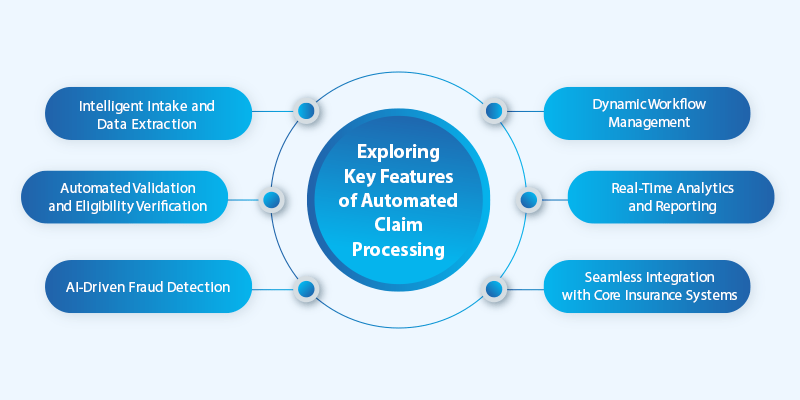
Intelligent Intake and Data Extraction
Leveraging AI-powered Optical Character Recognition (OCR) and Natural Language Processing (NLP), these systems can automatically capture and extract relevant data from diverse claim documents—whether they are scanned forms, PDFs, or handwritten notes. This minimizes manual data entry, enhances accuracy, and speeds up initial claim registration.
Submitted claim data is automatically cross-referenced with policy details, coverage limits, and historical claim records. This early-stage verification ensures eligibility, flags inconsistencies, and prevents errors from progressing further in the workflow.
AI-Driven Fraud Detection
Machine learning models continuously analyze claim data to detect unusual patterns or anomalies indicative of fraud. Suspicious claims are proactively flagged for human investigation, significantly reducing the risk of financial losses and improving security.
Dynamic Workflow Management
Claims are intelligently routed based on predefined rules, complexity, and severity. Straightforward cases can be processed automatically through straight-through processing, while more complex claims are assigned to specialized adjusters. This optimizes resource allocation and ensures timely resolutions.
Real-Time Analytics and Reporting
Interactive dashboards and customizable reports provide actionable insights into claim volumes, processing times, operational costs, and adjuster performance. These analytics enable data-driven decision-making, continuous process optimization, and improved service delivery.
Seamless Integration with Core Insurance Systems
Automated claims solutions integrate effortlessly with policy administration, billing, and other core insurance platforms. This ensures a unified view of customer and policy data, promotes smooth information flow, and eliminates data silos between departments.

Conclusion
In an increasingly competitive insurance landscape, manual claims processing is no longer sustainable. Its inherent delays, high operational costs, and risk of errors directly impact both profitability and customer satisfaction. Automated claims processing transforms this reality by leveraging AI, machine learning, and intelligent workflows to streamline every stage of the claims’ lifecycle from intake and verification to adjudication and settlement.
The benefits are clear, faster turnaround times, improved accuracy, better fraud detection, enhanced scalability, and a more transparent, customer-centric experience. Moreover, real-time analytics and seamless system integration empower insurers with actionable insights and operational agility, enabling them to adapt quickly to market demands and regulatory changes.
Empower your insurance business with faster settlements, improved accuracy, and a superior customer experience. Connect with Espire and implement intelligent claims automation tailored to your needs.