How AI and Omnichannel Engagement Are Shaping the New Insurance Standard
Insurance has always been about trust. Customers expect their insurers to be dependable in the most critical moments of their lives, whether it’s a health emergency, a car accident, or planning for the future. Yet, the modern insurance landscape is no longer defined by policies alone; it’s defined by experiences. A customer might begin a conversation through a website chatbot, switch to email, and then expect a follow-up call - all while anticipating consistency, empathy, and speed.
This is where the intersection of omnichannel strategy and AI is proving to be transformative. Together, they are not just reshaping how insurers communicate with policyholders, but also how they deliver value across the entire customer journey.
Rising Customer Expectations in the Insurance Journey
When someone purchases an insurance policy, they’re not just buying financial protection, they’re investing in peace of mind. This makes the insurance customer journey uniquely emotional compared to other industries. A policyholder dealing with a car accident, a medical emergency, or a property loss wants reassurance that their insurer will respond swiftly, fairly, and with empathy. These deeply human needs have reshaped what customers now expect from insurers:
Seamless and Consistent Experiences
Modern customers interact with brands across multiple channels such as apps, websites, emails, chatbots, and contact centers. In insurance, they expect to move effortlessly between these touchpoints without starting over. For example, a customer filing a claim via mobile should be able to follow up through a call or chatbot without repeating details. Consistency is no longer a nice-to-have; it is a fundamental expectation.
Always-On, Real-Time Support
Emergencies don’t follow office hours. Whether a claim arises at midnight or a policy query comes up during a weekend trip, customers expect 24/7 availability. Delayed responses can erode trust quickly, especially when customers are already under stress. Insurers must deliver instant assistance powered by AI and automation to stay relevant.
Personalization Beyond Policy Numbers
Generic communication - such as sending the same renewal reminder to every customeris no longer effective. Policyholders want insurers to know them, anticipate their needs, and provide proactive guidance. For example, a young family expects advice on life cover or child health insurance, while a retiree may need updates on senior health policies. Personalization at scale has become a key differentiator.
Transparency and Trust in Every Interaction
Insurance is often criticized for complex terms, hidden conditions, and slow claims processes. Customers now demand clarity, transparency, and fairness at every stage from policy documents to claims settlement. Insurers that can simplify jargon and communicate openly will stand out in a competitive market.
Empathy-Driven Engagement
Perhaps the most important expectation is human-centered communication. Unlike retail or travel, insurance conversations often take place during difficult times after an accident, illness, or loss. Customers value not just efficiency but also compassionate engagement that reassures them they are being cared for.

How AI-Powered Omnichannel Support is Redefining Insurance
Imagine a policyholder who starts by asking a chatbot about motor insurance coverage, then sends documents over email, and finally receives a confirmation call from an agent. In the past, these interactions would have been disconnected, often requiring the customer to repeat details multiple times. Today, however, AI-powered omnichannel support ensures that every touchpoint is seamlessly connected creating a consistent, personalized, and efficient customer journey.
The Role of AI in Omnichannel Insurance
AI is not just an add-on - it is the force that makes omnichannel support smarter, faster, and more human:
- AI Virtual Assistants & Chatbots: Provide instant responses for FAQs, claims status, and policy details, reducing wait times and freeing human agents for complex cases.
- Predictive Analytics: Anticipates customer needs, such as suggesting travel insurance when a customer buys a flight ticket using a linked card.
- Natural Language Processing (NLP): Enables insurers to understand intent and emotion in conversations, ensuring empathetic responses even in automated interactions.
- Sentiment Analysis: Detects frustration or urgency in customer tone and escalates queries to live agents, ensuring sensitive cases receive the right attention.
- Unified Customer Profiles: AI consolidates data from multiple channels into a single, 360-degree view, enabling agents to deliver consistent, context-rich service.
Setting the New Standard for Insurance Experience
The true value of AI-driven omnichannel support lies in redefining what customers expect from insurers. It allows insurance companies to:
- Deliver always-on support across channels without compromising quality.
- Ensure personalized and proactive engagement that feels tailor-made for each policyholder.
- Maintain consistency and transparency, even when customers switch between digital and human interactions.
- Build deeper trust and loyalty, by showing empathy powered by data-driven intelligence.
This fusion of AI in insurance and omnichannel engagement has moved beyond being an innovation—it has become the new standard for insurers looking to remain competitive in a market where customer experience is everything.
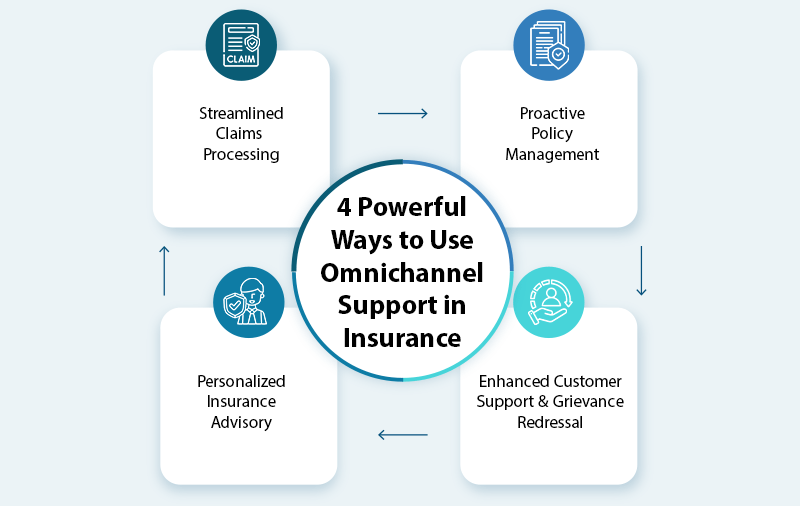
4 Powerful Ways to Use Omnichannel Support in Insurance
Omnichannel support in insurance is not just about offering multiple communication options—it’s about creating a connected, intelligent, and human experience across every stage of the policyholder journey. When powered by AI, omnichannel engagement enables insurers to deliver timely, personalized, and empathetic interactions that build trust and loyalty.
Here are the four most impactful ways insurers can leverage omnichannel support:
Streamlined Claims Processing
The moment of truth for any insurance company is the claims process. For customers, this is often an emotional and stressful experience. A fractured or delayed process can erode trust permanently.
With AI-driven omnichannel claims automation, insurers can make claims effortless and transparent. A policyholder might start by initiating a claim on a mobile app, upload photos of damages via email, and later receive real-time updates. AI ensures documents are validated quickly, fraud risks are flagged, and settlement timelines are communicated clearly.
Proactive Policy Management
Customers often struggle to keep track of policy renewals, premium payments, or add-on covers. Missed deadlines not only inconvenience the customer but also impact the insurer’s retention rate.
Omnichannel policy management ensures that reminders and notifications reach customers on their preferred channels—be it email, app notifications, or even voice calls. AI adds intelligence by anticipating needs based on life events. For example, a young couple adding a new family member could be proactively informed about child health coverage, while someone nearing retirement might be guided toward pension-linked plans.
Personalized Insurance Advisory
Insurance is no longer about one-size-fits-all policies. Customers expect advice tailored to their unique circumstances, financial goals, and lifestyle.
With AI-powered data insights, insurers can create detailed customer profiles that enable personalized recommendations. Imagine a customer browsing for travel insurance online, an AI system can recognize their frequent international travel pattern and suggest annual multi-trip coverage, instead of a basic single-trip policy.
By integrating these insights across all touchpoints including apps, chat, agents, and email, customers experience consistency and relevancy regardless of how they choose to engage.
Enhanced Customer Support & Grievance Redressal
A customer reaching out with a concern expects quick, accurate, and empathetic resolutions. Traditional support systems often struggle with siloed channels, leading to repeated explanations and delayed outcomes.
With AI-enabled omnichannel support, a complaint initiated via chatbot can be tracked, escalated through email, and followed up by a live agent call, all with full visibility of the issue history. Sentiment analysis ensures urgent or sensitive cases are prioritized, while unified dashboards allow agents to respond with context.

Why Espire for Omnichannel Support in the Insurance Industry?
In an industry where customer trust is everything, insurers cannot afford fragmented interactions or outdated systems. Policyholders today expect experiences that are connected, personalized, and empathetic across all channels. This is where Espire stands out, not simply as a technology provider, but as a strategic partner in reshaping the insurance customer journey.
End-to-End Omnichannel Integration
Espire helps insurers move beyond multichannel setups to true omnichannel integration. We unify customer interactions across apps, chatbots, web portals, email, contact centers, and physical agents, ensuring a consistent, 360-degree view of each policyholder. This eliminates silos, reduces redundancy, and delivers seamless experiences customers can trust.
AI-Enabled Personalization and Proactive Engagement
With AI and advanced analytics at the core, our solutions enable insurers to anticipate customer needs before they arise. From recommending add-on covers based on life events to providing instant claims updates, Espire ensures every touchpoint is timely, relevant, and empathetic.
Scalable and Future-Ready Solutions
Whether you are a regional insurer looking to digitize customer engagement or a global enterprise seeking large-scale transformation, Espire’s solutions are built to scale effortlessly. We ensure future-readiness by embedding automation, AI, and integration capabilities that evolve with your business and customer demands.
Proven Expertise in Insurance Transformation
Espire brings decades of experience in driving digital transformation in insurance. Our global engagements with leading insurers demonstrate our ability to blend technology, domain knowledge, and customer-centric design to deliver measurable outcomes, improved claims turnaround times, higher retention rates, and enhanced customer satisfaction.
Conclusion
The insurance industry is entering a defining moment where AI and omnichannel support will determine which insurers thrive in a customer-first economy. From claims automation to proactive engagement and personalized advisory, the highest impact lies in creating journeys that are seamless, empathetic, and intelligent.
Insurers who embrace this transformation can move beyond transactions to become true partners in their customers’ lives. With Espire as a strategic partner, insurers can unlock the power of AI-driven omnichannel support to build stronger trust, deliver superior experiences, and drive long-term growth. Connect with Espire, an explore new opportunities for your insurance business with AI.