Data-Driven Sustainability: Using Analytics to Reduce Carbon Footprint in Logistics
Logistics is growing fast and so is the sustainability spotlight on it. Globally, the logistics market was estimated at ~USD 3.93 trillion in 2024 and is projected to reach ~USD 5.95 trillion by 2030 (7.2% CAGR), which means more shipments, more facilities, and more transport activity to manage efficiently.
At the same time, freight movement has become a material emissions challenge. Freight transportation alone contributes around 8% of global greenhouse gas emissions, and that number can rise to ~11% when warehouses and ports are included making logistics one of the most actionable areas for real-world decarbonization.
What’s changed is expectations. Regulators are tightening reporting norms (for example, the EU’s CSRD begins applying to the first set of companies for FY2024 reporting published in 2025), and supply chain emissions are increasingly part of what organizations must measure and disclose. At the same time, customers want greener logistics but many don’t want to pay a premium for it, which puts pressure on logistics and supply-chain leaders to cut carbon without inflating costs.
That’s why data-driven sustainability is becoming the practical path forward. With analytics, logistics teams can move beyond estimates and periodic audits to pinpoint emission hotspots, optimize routes and loads, reduce empty miles, improve energy efficiency in warehouses, and track progress continuously turning carbon reduction into something measurable, manageable, and repeatable.
Understanding Carbon Footprint in Logistics
Understanding the carbon footprint in logistics goes far beyond counting fuel usage. It requires a holistic view of how goods move, where energy is consumed, and how operational decisions translate into emissions across the supply chain.
What Constitutes a Logistics Carbon Footprint
A logistics carbon footprint represents the total greenhouse gas (GHG) emissions generated across transportation, warehousing, and distribution activities. This includes direct emissions from fuel combustion in trucks, ships, and aircraft, as well as indirect emissions from electricity used in warehouses, sorting centers, and cold storage facilities. Even supporting activities like packaging, vehicle idling, and empty return trips contribute to the overall footprint.
Transportation as the Largest Emissions Contributor
Transportation typically accounts for most logistics-related emissions. Long-haul trucking, last-mile delivery, air freight, and intermodal transport all differ significantly in their carbon intensity. Poor route planning, low vehicle utilization, traffic congestion, and inconsistent driving behavior amplify emissions, making transportation optimization one of the most impactful sustainability levers.
Warehouse and Fulfillment Center Emissions
Warehouses contribute to the carbon footprint through energy-intensive operations such as lighting, heating, cooling, automation systems, and material handling equipment. Older facilities with inefficient layouts or outdated infrastructure often consume more energy than necessary, quietly inflating emissions even when transportation is optimized.
Scope 1, Scope 2, and Scope 3 Emissions in Logistics
Logistics emissions span multiple reporting scopes.
- Scope 1 includes direct emissions from owned fleets and onsite fuel usage.
- Scope 2 covers indirect emissions from purchased electricity used in warehouses and offices.
- Scope 3 emissions extend to third-party carriers, suppliers, and outsourced logistics partners often the hardest to track but the largest in volume.
Understanding these scopes is critical for accurate reporting and meaningful reduction strategies.
Why Measurement Is the Foundation of Reduction
Without accurate and granular measurement, carbon reduction remains theoretical. Organizations need reliable data to identify emission hotspots, compare transport modes, evaluate operational trade-offs, and prioritize high-impact interventions. A clear understanding of the logistics carbon footprint transforms sustainability from a compliance obligation into a data-backed operational strategy.
Challenges in Traditional Carbon Tracking
Manual Data Collection Leads to Inaccurate Emissions Tracking
Many logistics organizations still rely on spreadsheets, manual reports, and fragmented data sources to estimate emissions. This approach is not only time-consuming but also prone to errors and inconsistencies. Inaccurate data makes it difficult to establish a reliable emissions baseline, leading to flawed sustainability reporting and ineffective reduction strategies.
Lack of Real-Time Logistics Data Makes It Hard to Implement Changes
Traditional tracking methods often operate on delayed or historical data. Without real-time visibility into fleet movements, fuel usage, or warehouse operations, organizations struggle to respond proactively. Sustainability initiatives become reactive rather than predictive, limiting the ability to reduce emissions as operations unfold.
Inefficient Route Planning Results in Higher Carbon Emissions
Route planning that doesn’t factor in real-time traffic, vehicle capacity, or delivery consolidation leads to unnecessary miles driven and increased fuel consumption. These inefficiencies directly contribute to higher carbon emissions and inflated operational costs, making sustainability goals harder to achieve.
Companies Struggle to Measure Their Supply Chain Sustainability Impact
Logistics networks typically involve multiple partners, vendors, and carriers, each with different data standards and reporting mechanisms. This lack of end-to-end visibility makes it difficult for companies to measure the true sustainability impact of their entire supply chain, resulting in incomplete or misleading carbon assessments.
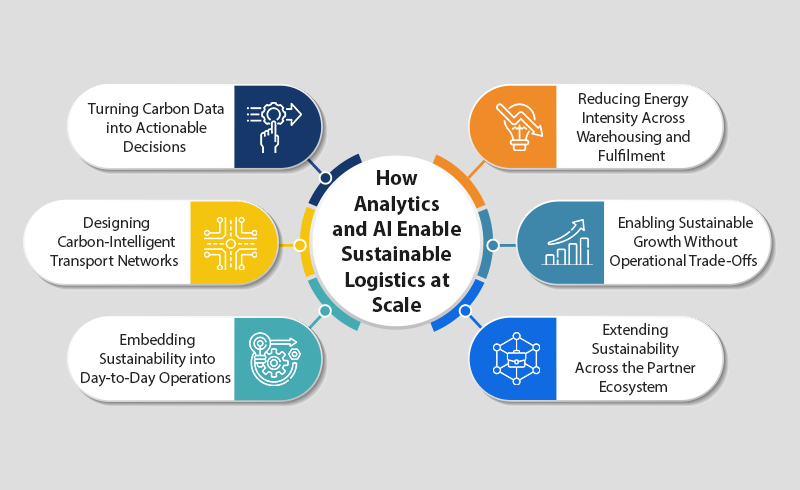
How Analytics and AI Enable Sustainable Logistics at Scale
Analytics and AI are not separate sustainability initiatives, instead, they are becoming the intelligence layer that connects carbon goals with everyday logistics decisions. When applied correctly, they translate sustainability ambition into measurable, repeatable operational impact.
Turning Carbon Data into Actionable Decisions
Modern analytics platforms aggregate emissions, fuel usage, vehicle performance, and facility energy data into a single view. AI transforms this data into prioritised actions highlighting where emissions can be reduced immediately, where process changes will deliver the highest impact, and where investments will yield long-term sustainability gains.
Designing Carbon-Intelligent Transport Networks
AI evaluates transport networks such as routes, hubs, vehicle types, and delivery frequency holistically to design networks that minimise emissions rather than just distance or cost. This enables logistics teams to reduce empty miles, improve load efficiency, and shift to lower-carbon transport modes where viable.
Embedding Sustainability into Day-to-Day Operations
Instead of sustainability being reviewed monthly or quarterly, AI brings it into daily execution. Real-time insights allow logistics teams to adjust routes, consolidate shipments, and manage fleet behaviour dynamically reducing emissions while operations are live, not after reports are generated.
Reducing Energy Intensity Across Warehousing and Fulfilment
Advanced analytics identifies energy inefficiencies within warehouses, from peak-load patterns to underutilised automation systems. AI-driven optimisation helps facilities reduce energy per order, align operations with lower-carbon energy availability, and continuously improve emissions performance.
Enabling Sustainable Growth Without Operational Trade-Offs
AI-powered forecasting aligns logistics capacity with demand more accurately. This prevents over-transportation, excess inventory movement, and unnecessary energy consumption allowing organisations to scale operations without proportionally increasing their carbon footprint.
Extending Sustainability Across the Partner Ecosystem
Analytics enables consistent measurement of emissions across carriers, suppliers, and third-party logistics partners. AI-driven benchmarking encourages greener partner selection and fosters data-backed collaboration on emission reduction across the broader supply chain.
Espire’s AI-Powered Solutions for Sustainable Logistics
AI-Driven Carbon Emissions Analytics
Espire delivers AI-powered analytics platforms that consolidate logistics data across transportation, warehousing, and partners to provide a single, accurate view of carbon emissions. This enables organizations to move from estimations to precise, audit-ready sustainability insights.
Intelligent Route and Load Optimization
Espire applies advanced AI algorithms to optimize routes and load planning in real time. By balancing delivery timelines with fuel efficiency and capacity utilization, logistics teams can reduce emissions while improving cost efficiency and service reliability.
Real-Time Visibility with Predictive Insights
Through integration with IoT devices and logistics systems, Espire enables real-time tracking of fleet performance and emissions. Predictive analytics help organizations anticipate inefficiencies and take proactive steps to lower their environmental impact before issues escalate.
End-to-End Supply Chain Sustainability Measurement
Espire’s solutions provide end-to-end visibility into complex logistics networks, helping organizations measure, monitor, and report sustainability metrics across carriers, suppliers, and distribution partners. This creates transparency and accountability across the supply chain.
Actionable Sustainability Dashboards for Decision-Makers
Espire empowers business leaders with intuitive dashboards that translate complex sustainability data into actionable insights. These dashboards enable smarter decisions, regulatory compliance, and continuous progress toward long-term carbon reduction goals.
Conclusion
Sustainable logistics is no longer about intent it’s about intelligence. Organizations that embrace data-driven sustainability can transform carbon reduction from a reporting exercise into a strategic advantage. With analytics and AI, logistics leaders can reduce emissions, optimize operations, and build resilient, future-ready supply chains.
Ready to reduce your logistics carbon footprint with data and AI?
Connect with Espire to explore how analytics-driven sustainability can help your organization achieve measurable environmental and business outcomes today and for the long term.