Cybersecurity at Sea: Protecting the Digital Port Ecosystem in an Era of Rapid Transformation
The maritime industry has entered a new era, one where digital systems, automated operations, and interconnected port infrastructures power global trade. But as ships, terminals, and logistics networks become more intelligent, they also become prime targets for cyberattacks. Over the past few years, attacks on major shipping lines, ports, and logistics operators have disrupted supply chains, halted vessel operations, and caused millions in losses. For a sector that enables over 80% of global trade, a single cyber breach can ripple across continents.
As every industry accelerates toward digital transformation, safeguarding the digital maritime ecosystem is no longer optional, it’s a strategic necessity. Strong cybersecurity is now as critical as physical port security, ensuring business continuity, operational resilience, and safe maritime movement in an increasingly hostile cyber landscape.

Overview of the Current Cybersecurity Landscape in the Global Maritime Sector
Maritime businesses today operate within a complex, digitally dependent ecosystem that spans vessels, terminals, port authorities, logistics providers, and global communication networks. Technologies such as IoT devices, GPS navigation, OT (Operational Technology) systems, AIS trackers, EDI platforms, and cloud-based port management systems have become fundamental to daily operations.
However, this rapid digital expansion has outpaced cybersecurity readiness. Many ports and vessels still rely on outdated legacy systems, unpatched software, and siloed networks. OT environments, traditionally designed for reliability, not cyber defense, are increasingly being exposed to the internet, making them vulnerable to ransomware, malware, and remote intrusions.
Regulatory bodies like the IMO (International Maritime Organization) and regional authorities have introduced cybersecurity guidelines, yet compliance levels vary significantly across ports and operators. As cybercriminals continue to evolve, maritime organizations must strengthen their capabilities to combat a growing wave of sophisticated threats.
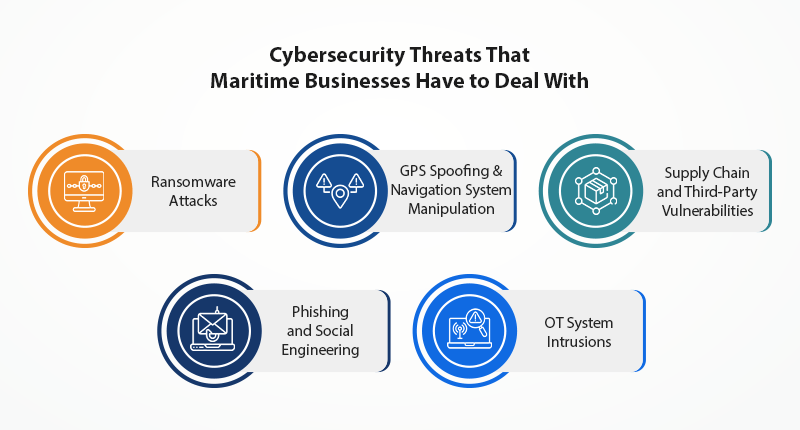
Cybersecurity Threats That Maritime Businesses Have to Deal With
Ransomware Attacks
Ransomware remains one of the most disruptive threats in the maritime world. By encrypting critical systems such as port management platforms, container tracking software, or vessel navigation tools, attackers can halt operations entirely. Several global shipping giants have suffered week-long shutdowns, resulting in massive operational and financial losses.
GPS Spoofing and Navigation System Manipulation
Maritime navigation heavily relies on GPS and AIS data. Cybercriminals can exploit this dependency by sending false location signals, causing ships to drift off course or misinterpret their surroundings. Such interference threatens not only operational efficiency but also maritime safety, increasing the risk of collisions and grounding.
Supply Chain and Third-Party Vulnerabilities
Ports and shipping companies work with a vast network of vendors each with varying levels of cybersecurity maturity. Attackers often exploit weak links in the supply chain to infiltrate core systems. A compromised logistics partner or EDI system can become the entry point for widespread port or fleet disruptions.
Phishing and Social Engineering
Human error remains a major vulnerability. Maritime personnel, whether onboard vessels or at port offices regularly receive fraudulent emails crafted to steal credentials or deploy malware. The industry’s reliance on remote communication, documentation exchange, and authorizations makes phishing an especially potent threat.
OT System Intrusions
Operational Technology systems manage cranes, loading arms, fuel pumps, and other critical infrastructure. Many OT networks were not designed with cybersecurity in mind and remain poorly isolated from IT systems. A breach could lead to physical damage, shutdowns, or unsafe equipment behavior, posing significant risks to port safety and operations.
Strategies to Mitigate Cybersecurity Threats in the Maritime Sector
Strengthening cybersecurity in the maritime industry requires a holistic, multi-layered defense strategy that protects both Information Technology (IT) systems and Operational Technology (OT) infrastructures. Ports, vessels, and logistics networks operate in a highly interconnected environment, so mitigation efforts must blend technology, process, and people to create a resilient security posture. Below are the key strategies maritime organizations must adopt to stay ahead of evolving threats:
Establish Strong Cyber Governance and Risk Management Frameworks
Effective cybersecurity begins with governance. Maritime operators need to define clear roles, ownership structures, and policies that guide cyber defense activities across the entire ecosystem. This includes:
- Creating cybersecurity policies aligned with IMO 2021, NIST, and ISO standards
- Conducting regular cyber risk assessments across IT, OT, and third-party systems
- Prioritizing vulnerabilities based on business impact and operational criticality
- Developing incident response playbooks tailored to maritime operations
A well-structured governance model ensures accountability and enables faster, more coordinated responses when threats arise.
Strengthen Network Segmentation and Access Controls
Ports and vessels rely on numerous interconnected systems from cargo handling equipment to navigation tools, making segmentation critical to limiting cyberattack spread.
Key steps include:
- Separating IT and OT networks through strict access boundaries
- Implementing Zero Trust policies, ensuring users and devices verify continuously
- Enforcing least-privilege access and role-based authentication
- Using multi-factor authentication (MFA) across all critical systems
By preventing unauthorized lateral movement, operators can significantly reduce the risk of ransomware outbreaks or system takeovers.
Deploy Advanced Threat Detection and Continuous Monitoring
Modern cyberattacks are fast, stealthy, and often automated. Maritime organizations need real-time visibility into their systems to detect anomalies before they cause damage.
This involves:
- Implementing Security Information and Event Management (SIEM) solutions
- Using AI-based intrusion detection and behavioral analytics
- Monitoring OT systems for unusual changes in equipment behavior
- Establishing a 24/7 Security Operations Center (SOC) for continuous oversight
These capabilities help teams identify suspicious activities early and respond before attackers compromise critical systems.
Strengthen Endpoint Security and Ransomware Defense
Given the rise of remote operations and connected devices, endpoints- including onboard ship systems, handheld devices, and port machinery - have become prime entry points for attackers.
Mitigation practices include:
- Deploying EDR (Endpoint Detection & Response) solutions
- Ensuring reliable backup and recovery processes for critical operational data
- Using encrypted communication channels for ship-to-shore interactions
- Maintaining strict whitelisting of approved software
These measures minimize ransomware risks and keep operations functional even during attempted intrusions.
Secure Supply Chain and Third-Party Integrations
Ports and shipping companies rely on hundreds of vendors, each introducing potential vulnerabilities. A breach in a small vendor system can quickly escalate into a disruption across the port ecosystem.
Mitigation steps include:
- Performing third-party security audits
- Enforcing cybersecurity requirements in vendor contracts
- Scanning software updates and external applications before deployment
- Monitoring EDI systems and API connections for anomalies
A secure maritime ecosystem requires every link in the chain to be protected.
Regular Patching, Vulnerability Management, and System Hardening
Legacy and unpatched systems are among the leading causes of maritime cyber incidents.
To reduce this risk:
- Maintain a structured patch management schedule for IT and OT assets
- Remove outdated hardware or unsupported software whenever feasible
- Harden shipboard and port systems by disabling unnecessary services
- Conduct periodic penetration testing to identify weaknesses earlier
The goal is to close security gaps before attackers discover and exploit them.

How Espire Helps Maritime Businesses with Cybersecurity
Espire empowers maritime organizations with end-to-end cybersecurity solutions designed for the complexities of modern port and vessel ecosystems. With deep expertise in securing both IT and OT environments, Espire helps maritime businesses build robust, future-ready security frameworks.
AI-Powered Threat Detection and Response
Espire integrates AI and machine learning models into security operations to detect anomalies faster and more accurately than traditional methods. AI continuously monitors network traffic, OT equipment behavior, and port management systems to identify unusual patterns, predict threats, and trigger immediate alerts. This enables maritime organizations to:
- Spot ransomware or malware activity before it spreads
- Identify abnormal vessel navigation or OT system behavior
- Reduce false positives and accelerate incident triage
- Automate parts of the response workflow for faster containment
AI-driven security gives maritime operators a critical advantage against increasingly sophisticated cyberattacks.
Risk Assessment
Espire conducts comprehensive security audits across your digital and operational infrastructure, identifying vulnerabilities, misconfigurations, and high-risk areas. This allows maritime leaders to prioritize investments and strengthen defenses based on real-world risk exposure.
Ransomware Protection
Through advanced threat detection, endpoint protection, and automated response mechanisms, Espire helps businesses prevent, contain, and recover from ransomware attacks ensuring minimal downtime and safeguarding critical port operations.
Data Loss Prevention (DLP) Solutions
Espire’s DLP strategies secure sensitive data across vessel communication systems, port management platforms, and connected logistics networks. This protects business-critical information from unauthorized access, leaks, or tampering.
Network Security
From firewalls and intrusion detection systems to zero-trust architectures, Espire designs secure, resilient network environments that prevent cybercriminals from infiltrating maritime systems.
Penetration Testing
Espire’s ethical hacking teams simulate real-world attacks to uncover system weaknesses before criminals exploit them. These controlled tests provide actionable insights to strengthen digital and operational systems.
Patch and Update Management
Legacy and unpatched systems are among the biggest risks in maritime operations. Espire ensures timely updates, patch deployment, and system hardening to minimize exposure across both IT and OT environments.
Conclusion
As the maritime world becomes increasingly digital, cybersecurity must become a top strategic priority. Protecting the digital port ecosystem is essential not just for operational continuity—but for the stability of global trade itself. By embracing modern cybersecurity strategies and partnering with experts like Espire, maritime businesses can safeguard their future and operate with confidence in an evolving digital landscape.
Ready to secure your maritime operations? Connect with Espire’s cybersecurity specialists today.