AI-Powered Fraud Defense: Reimagining Financial Crime Detection with Graph Analytics
Financial crime has evolved faster than most traditional detection systems can keep up with. Fraudsters today operate through sophisticated digital channels, hide behind synthetic identities, and leverage global networks of mule accounts to evade detection. As transaction volumes surge and digital financial services expand, organizations face an unprecedented challenge: how to distinguish legitimate customer behavior from rapidly evolving fraud patterns, without overwhelming compliance teams or compromising customer experience.
This is where AI and Graph Analytics are fundamentally transforming the fraud detection landscape. Instead of relying on rigid rules and reactive investigations, modern financial institutions are moving toward real-time, intelligence-driven systems capable of uncovering hidden patterns, exposing criminal networks, and preventing fraud before damage is done.

What are the Limitations in Traditional Systems Against Financial Crime
Outdated Rule-Based Platforms
Traditional fraud detection engines depend heavily on static, pre-defined rules such as transaction limits or location-based flags. While effective for basic checks, they fail to identify new fraud typologies, multi-channel schemes, and low-and-slow attacks that operate just beneath the threshold of detection. Fraudsters can easily bypass these legacy systems by simply adjusting their behavior.
High False Positives
One of the biggest drawbacks of conventional systems is the volume of false positives. Overly broad rules trigger unnecessary alerts, overwhelming fraud teams with manual case reviews. This slows down investigations, frustrates customers whose legitimate transactions get blocked, and drives up compliance costs.
Lack of Real-Time Monitoring and Context
Legacy platforms operate in batch mode, analyzing transactions hours, even days after they occur. Without real-time evaluation and contextual awareness, institutions miss critical opportunities to intercept fraudulent behavior before funds are withdrawn, laundered, or rerouted through mule accounts.
Fragmented Data and Poor Management
Financial crime thrives in data silos. Customer profiles, transaction logs, KYC data, device information, and third-party intelligence often remain disconnected. Without unified visibility, institutions cannot identify relational patterns such as network collusion, repeat offenders, or cross-channel fraud activity.
Manual Processes and Human Error
Compliance teams often rely on spreadsheets, manual triage, and case-by-case investigations. This not only delays fraud resolution but increases the risk of oversight, misclassification, or regulatory non-compliance, especially when dealing with high transaction volumes.
Evolving Criminal Tactics
Fraudsters continuously adapt using machine learning, social engineering, synthetic identities, and global mule networks to avoid detection. Traditional systems lack the agility to adjust quickly, leaving institutions one step behind emerging threats.
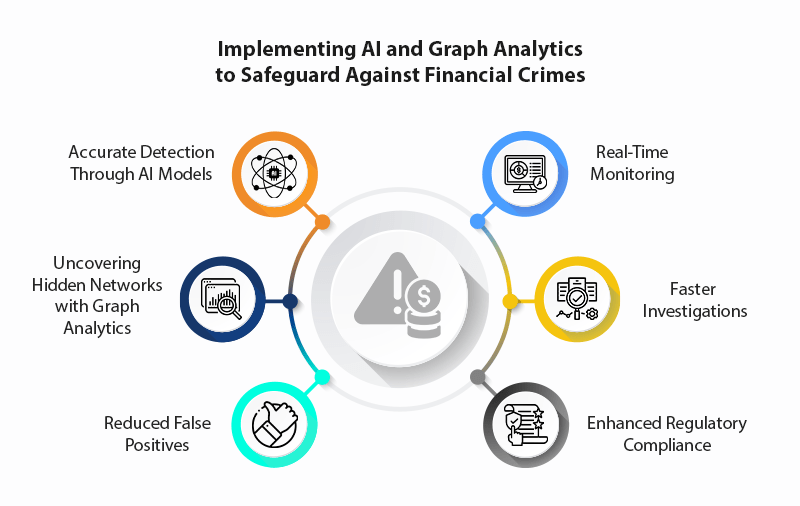
Implementing AI and Graph Analytics to Safeguard Against Financial Crimes
Accurate Detection Through AI Models
AI-driven fraud models learn from massive datasets such as customer behavior, device metadata, geolocation, and historical fraud cases to identify hidden anomalies. Unlike rules that check predefined thresholds, machine learning models evolve with new behavior patterns, identifying subtle signals of suspicious activity long before a human analyst could.
Uncovering Hidden Networks with Graph Analytics
Graph analytics maps relationships between entities including accounts, devices, addresses, transactions even when they appear unrelated at the surface. This approach makes it possible to detect:
- Money laundering clusters
- Fraudulent loan stacking
- Multi-account takeovers
- Synthetic identity fraud rings
By visualizing relationships instead of isolated transactions, financial institutions can reveal full criminal networks in seconds.
Reduced False Positives
AI-powered triage engines refine alert accuracy by analyzing context, historical behavior, and entity relationships. Leading institutions have reported 60–80% reductions in false positives, enabling fraud teams to prioritize genuine threats instead of chasing noise.
Real-Time Monitoring
Modern fraud prevention uses stream processing and real-time AI scoring, allowing banks to detect suspicious transactions within milliseconds. This shift from batch to live analysis prevents illicit transfers before the money moves beyond recovery.
Faster Investigations
Graph visualization tools simplify complex investigations. Compliance teams can instantly understand the relationships between accounts, identify money flow patterns, and reconstruct fraud routes reducing multi-day investigations into a few hours.
Enhanced Regulatory Compliance
Explainable AI (XAI) makes it easier to document why a transaction was flagged. This transparency strengthens audit trails and ensures adherence to global regulatory standards such as FATF, FinCEN, PSD2, and local AML guidelines.
Emerging AI Innovations Redefining Fraud Prevention
Graph Neural Networks (GNNs) for Deep Structural Insight
Modern fraud detection is being transformed by Graph Neural Networks (GNNs), which analyze financial ecosystems as interconnected networks rather than isolated transactions. By learning from relationships across accounts, devices, identities, and transactions, GNNs detect hidden fraud rings, multi-step laundering flows, mule networks, and synthetic identities that traditional systems fail to notice.
Generative AI for Simulating Future Fraud Scenarios
Generative AI is helping institutions prepare for emerging risks by generating realistic synthetic fraud data, commonly known as “fraud twins.” By expanding the variety of fraud scenarios available for training, it enables detection models to predict future tactics, adapt faster, and shift from reactive detection to proactive fraud prevention.
Agentic AI for Autonomous Real-Time Decisioning
Agentic AI introduces autonomous agents capable of monitoring transactions in real time and making intelligent decisions to approve, challenge, or block activities. These agents continuously learn from evolving behavior patterns, greatly reducing manual review workloads while ensuring transparency and regulatory compliance through explainable decision-making.
Multi-Modal Data Fusion for Holistic Risk Visibility
Multi-Modal Data Fusion integrates diverse data sources graph relationships, behavioral biometrics, device intelligence, and unstructured text analyzed through NLP to create a unified, 360-degree view of user identity and risk. This layered approach significantly enhances accuracy by evaluating multiple behavioral and contextual signals simultaneously.

How Espire Helps Businesses Combat Financial Crime Using AI and Graph Analytics
Espire brings deep expertise in modernizing fraud detection ecosystems for BFS, fintech, insurance, and digital-first institutions. Our approach blends the power of AI, graph analytics, data engineering, and domain-driven compliance frameworks to deliver a holistic fraud defense architecture.
Our Capabilities Include
AI-Driven Fraud Modeling
We design and deploy adaptive ML models trained on high-volume transactional datasets to enable precise anomaly detection and significantly reduce false alerts.
Graph-Based Fraud Intelligence
Espire builds entity graphs that visualize relationships across customers, devices, channels, and transaction histories, enabling institutions to expose coordinated fraud networks.
Unified Data Pipelines
Our data engineering teams integrate siloed systems such as core banking, payment systems, CRM, KYC, digital channels into a single, high-quality data layer essential for modern fraud detection.
Real-Time Monitoring and Alerting
Using streaming platforms and AI-driven rules, we help organizations shift from reactive investigation to real-time fraud interdiction.
Investigation Acceleration
With graph visualizations and automated case building, Espire equips compliance teams with intelligence-driven tools to resolve cases faster.
Regulatory Confidence
Our solutions embed auditability, policy alignment, and explainable AI to help institutions seamlessly meet global financial crime regulations.
Conclusion
Financial crime will continue to grow in sophistication, but your detection systems can grow smarter, faster, and more resilient. By combining AI’s predictive intelligence with Graph Analytics’ relational insights, organizations can uncover hidden fraud networks, reduce false positives, accelerate investigations, and strengthen regulatory compliance while protecting customer trust.
Ready to modernize your fraud detection ecosystem?
Connect with Espire to transform your financial crime strategy with AI and Graph-powered intelligence.