Beyond the Horizon: How Smart Ports Powered by Data & AI Are Reimagining Maritime Operations
Ports are the beating heart of global trade, yet many still operate with processes designed for a different era. As the maritime ecosystem becomes more interconnected and customer expectations evolve, traditional port operations are finding it harder to keep pace. Manual workflows, fragmented systems, and limited real-time visibility create bottlenecks that hinder efficiency, increase operational costs, and slow down the movement of goods.
But a quiet revolution is already underway. Advances in data, automation, and artificial intelligence are transforming how ports navigate daily operations, from vessel movement and cargo handling to safety, sustainability, and supply chain collaboration. Smart ports are no longer an aspiration; they’re rapidly becoming the new operating model for forward-looking port authorities and terminal operators.
In this new landscape, the ports that thrive will be the ones that embrace intelligent, connected, and predictive systems, unlocking faster operations, deeper insights, and a more resilient future for maritime trade.

The Challenges with Yesterday’s Port
Operational Complexities
Traditional ports operate within a highly fragmented ecosystem where multiple stakeholders from shipping lines to customs authorities rely on disconnected systems and inconsistent data. This lack of synchronisation results in delays, bottlenecks, and inefficient decision-making, ultimately slowing down vessel and cargo movement.
Environmental Mandates
As global sustainability regulations tighten, legacy port infrastructure often struggles to keep pace. Outdated equipment, limited emissions monitoring, and manual compliance reporting make it difficult for ports to meet environmental targets, leading to increased operational and regulatory pressure.
Manual Operations
Many critical port processes such as berthing allocation, yard planning, inspections, and documentation are still managed manually. These paper-driven workflows introduce errors, slow down processes, and limit scalability at a time when container volumes and port traffic continue to grow.
Poor Connectivity and Information Gaps
Information silos across terminal systems, shipping partners, and government agencies create visibility gaps that disrupt smooth operations. Without real-time data on vessel ETA/ETD, cargo status, equipment health, or weather conditions, ports face congestion, longer dwell times, and reduced throughput.
Demand for Transparency
Global shippers, regulators, and logistics partners increasingly expect complete transparency across the maritime journey. Traditional ports struggle to deliver real-time visibility and predictive insights, making it difficult to meet evolving expectations for efficiency, accountability, and customer experience.
Digitalisation Isn’t Just a Trend, It’s a Strategic Enabler
Digital transformation in ports is not about adopting isolated solutions; it’s about building an integrated, intelligent ecosystem that improves every touchpoint of port operations. Smart ports combine IoT devices, connected infrastructure, digital twins, AI models, and real-time analytics to create a responsive environment where data continuously flows and informs decisions.
Embracing digitalisation enables ports to operate with far greater certainty. It brings together operational, environmental, logistics, and vessel data into unified platforms that provide a single version of truth for all stakeholders. This shift empowers ports to optimise resource allocation, reduce congestion, minimise emissions, and enhance throughput while ensuring compliance with international maritime standards. More importantly, it helps ports remain adaptive, capable of scaling operations, managing disruptions proactively, and meeting the evolving demands of global trade.
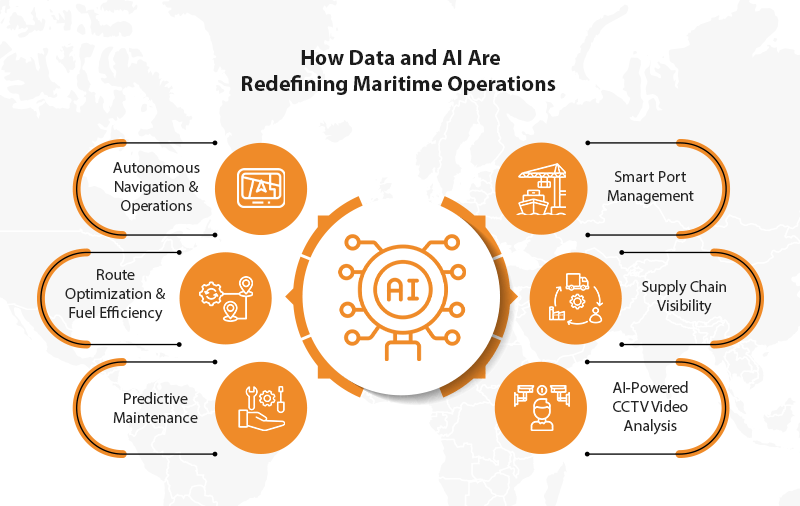
How Data and AI Are Redefining Maritime Operations
Autonomous Navigation & Operations
AI-driven autonomous systems are reshaping vessel movement by analysing traffic density, weather data, and ocean patterns in real time. These systems support safer navigation, automated docking, and precision manoeuvring while reducing human error and improving maritime safety.
Route Optimization & Fuel Efficiency
Fuel remains one of the largest expenses in maritime transport. AI-powered route optimisation evaluates ocean currents, historical sailing patterns, and predictive weather analytics to determine the most efficient routes, enabling cost savings and reducing carbon emissions.
Predictive Maintenance
Smart sensors and AI models help ports move from reactive repairs to predictive maintenance. By continuously monitoring equipment health, from cranes to AGVs, ports can detect anomalies early, prevent breakdowns, and maintain uninterrupted operations.
Smart Port Management
Data-driven management systems enable ports to orchestrate vessel scheduling, yard planning, gate operations, and workforce deployment with greater precision. Real-time intelligence reduces congestion, increases throughput, and optimises resource utilisation across terminals.
Supply Chain Visibility
AI and integrated data platforms provide end-to-end visibility across the maritime supply chain. Stakeholders gain real-time updates on cargo movement, container status, customs processes, and hinterland connectivity, improving alignment and reducing delays.
AI-Powered CCTV Video Analysis
Modern ports rely heavily on CCTV networks, but traditional surveillance only scratches the surface. AI-powered video analytics transforms cameras into intelligent monitoring tools capable of detecting unsafe behaviours, identifying intrusions, tracking container movements, and monitoring restricted zones. These systems can analyse thousands of video frames in real time, alerting operators instantly about potential hazards, unauthorized access, equipment idling, or operational inefficiencies. This not only enhances port security but also improves workforce safety, compliance, and overall situational awareness across terminals.

Espire’s Expertise in Smart Port Digital Transformation
Transforming Ports with Connected, Data-Driven Ecosystems
Espire enables ports to evolve from fragmented operational silos into connected, intelligence-led ecosystems. We integrate data from vessels, yard equipment, customs systems, cargo terminals, environmental sensors, and logistics partners to create a unified digital backbone. This ensures that every stakeholder works with a single, real-time source of truth. Our expertise lies in consolidating complex data landscapes into seamless, interoperable platforms that improve decision-making and unlock operational transparency across the maritime value chain.
AI-Driven Optimisation Across Port Operations
With advanced analytics and AI capabilities, Espire empowers ports to move beyond reactive operations. Our predictive models help anticipate congestion, optimise berth scheduling, manage yard utilisation, and forecast cargo arrival patterns. By analysing historical and real-time data simultaneously, we enable ports to plan proactively rather than respond to disruptions. AI-driven anomaly detection ensures equipment reliability, while intelligent automation accelerates documentation, inspection, and customs processes. This results in faster vessel turnaround, reduced operational overheads, and improved sustainability.
Digital Twins and Real-Time Visibility for Smarter Decisioning
Espire supports the implementation of digital twins that replicate port environments in real time. These virtual models map the movement of vessels, trucks, containers, and equipment, enabling operators to simulate scenarios, test decisions, and predict the impact of operational changes before applying them in the real world. Real-time dashboards provide visibility into yard performance, cargo flows, gate activities, environmental metrics, and workforce utilisation empowering port authorities with actionable insights for better planning and risk mitigation.
Modernising Legacy Infrastructure with Future-Ready Architecture
Many ports struggle with legacy applications and disconnected operational technology (OT) systems that limit modernisation. Espire helps modernise these systems with cloud-native, API-first, microservices-based architectures that support modular growth. We streamline integrations across TOS (Terminal Operating Systems), ERP, CRM, customs gateways, and third-party logistics platforms, ensuring that ports can adopt modern tools without disrupting existing workflows. Our approach creates a foundation for long-term scalability, resilience, and innovation.
Strengthening Sustainability, Safety, and Compliance
Smart port transformation is incomplete without strong environmental and regulatory alignment. Espire helps ports integrate emissions-monitoring systems, energy optimisation tools, digital documentation workflows, and automated compliance reporting. Through real-time data insights, ports can track fuel consumption, equipment emissions, waste metrics, and safety indicators. This ensures alignment with IMO standards, environmental protocols, and national maritime regulations, while also driving greener, safer operations.
A Partner for End-to-End Digital Transformation
From consulting and strategy to implementation and continuous optimisation, Espire serves as a long-term transformation partner for ports. Our multidisciplinary expertise combines AI, analytics, automation, integration engineering, user experience, and cloud modernisation to deliver a comprehensive transformation roadmap. We focus on creating ports that are operationally efficient, environmentally responsible, technologically advanced, and future ready.
Conclusion
The future of maritime trade belongs to ports that are intelligent, connected, and powered by real-time data. As global shipping demands intensify, smart ports will define the next era of operational excellence where vessels move with precision, cargo flows seamlessly, and every decision is driven by insight rather than guesswork. By embracing AI, automation, and integrated digital ecosystems, ports can unlock unprecedented efficiency, sustainability, and transparency.
Espire stands ready to help ports navigate this transformation with confidence. Our expertise in data integration, AI-driven optimisation, and modern digital architectures empowers port authorities and operators to move beyond traditional constraints and build future-ready, resilient port ecosystems.
If you're ready to modernise your port operations and accelerate your digital journey, connect with our experts today.