AI Security and Governance: Building Trust in the Age of Intelligent Enterprises
Artificial Intelligence is no longer experimental. It is embedded across customer service, underwriting, fraud detection, logistics, content generation, predictive analytics, and intelligent automation. Enterprises are deploying AI to enhance experience, optimize decisions, and accelerate growth.
But as AI systems become more autonomous and data-hungry, the risk surface expands. Sensitive data flows through large language models. Algorithms influence financial approvals. Intelligent agents act on behalf of users.
In this landscape, AI Security and Governance are no longer optional. They are foundational.
The Market Reality:
The global AI security and governance market is expanding rapidly as enterprises recognize regulatory, reputational, and operational risks tied to AI adoption. Industry analysts project sustained double-digit CAGR growth over the next decade.
This growth is driven by:
- Increasing regulatory oversight (AI Act, data protection laws, sectoral guidelines)
- Rising cyber threats targeting AI pipelines and models
- Demand for explainable, trustworthy AI systems
- Expansion of GenAI across enterprise workflows
- Higher board-level scrutiny on digital risk management
Organizations are moving from "Can we deploy AI?" to "Can we deploy AI responsibly, securely, and at scale?"
Why AI Security and Governance Matters Now
AI adoption has moved beyond experimentation. It now influences underwriting approvals, credit scoring, supply chain routing, employee screening, personalized marketing, fraud detection, and customer interactions. In many organizations, AI systems are directly impacting revenue, risk exposure, brand reputation, and regulatory standing.
When AI becomes embedded in core operations, security and governance become business-critical not just IT priorities.
The Growing Regulatory Landscape
Governments and regulatory bodies across the world are introducing structured frameworks for responsible AI usage. From data protection laws to AI-specific regulations, compliance expectations are tightening.
Organizations are now required to demonstrate:
- Transparency in automated decision-making
- Traceability of training data
- Bias mitigation controls
- Clear accountability structures
- Strong cybersecurity safeguards
Without a governance framework, proving compliance becomes nearly impossible. Proactive governance not only reduces legal exposure but also builds credibility with regulators and customers.
Rise of Generative AI and Autonomous Systems
The rapid adoption of GenAI and autonomous agents has increased exposure risks. Large language models process vast datasets, sometimes including proprietary or sensitive information. Agentic systems can make decisions or trigger actions without constant human intervention.
This shift introduces concerns such as:
- Data leakage and prompt injection attacks
- Model hallucinations impacting business decisions
- Unauthorized access to AI systems
- Misuse of AI-generated outputs
- Intellectual property exposure
Security-first AI architecture and defined guardrails are necessary to manage these evolving threats.
Security-first AI architecture and defined guardrails are necessary to manage these evolving threats.
AI failures are highly visible. A biased algorithm, inaccurate automated rejection, or data breach linked to AI can damage brand trust instantly.
Boards now view AI risk as part of enterprise risk management. Investors and stakeholders expect responsible AI policies, ethical oversight committees, and transparent reporting mechanisms.
Governance ensures AI initiatives align with strategic objectives while minimizing operational and reputational risks.
Increasing Cyber Threat Targeting AI
Attackers are adapting to AI ecosystems. Model poisoning, adversarial attacks, data inference attacks, and API exploitation are emerging threats targeting AI pipelines.
Traditional cybersecurity alone is insufficient. AI systems require additional controls, including:
- Secure model storage and versioning
- Controlled API gateways
- Continuous behavioral monitoring
- Segregated environments for training and deployment
- Zero-trust access mechanisms
Without structured AI security, organizations expose critical digital assets to advanced threat vectors.
Need for Scalable and Sustainable Innovation
Many enterprises are scaling AI across multiple departments simultaneously. Without governance standards, this expansion leads to:
- Shadow AI deployments
- Inconsistent validation practices
- Duplicate models
- Fragmented data usage
- Uncontrolled operational risk
A governance framework provides standardized templates, review processes, and lifecycle policies that allow innovation to scale safely and efficiently.
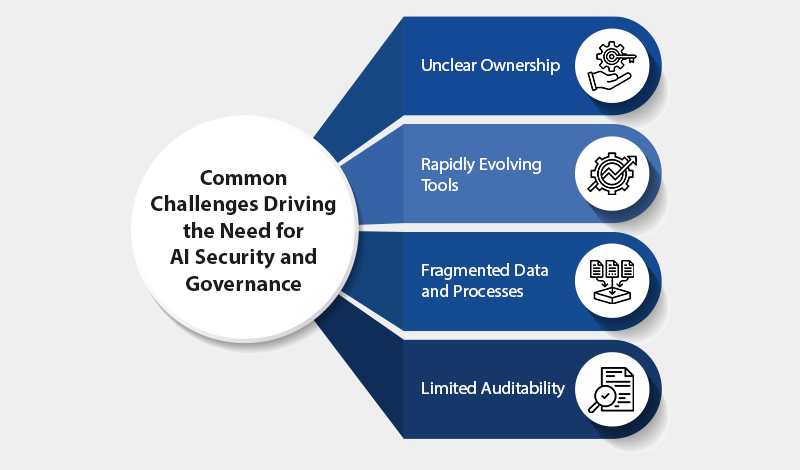
Common Challenges Driving the Need for AI Security and Governance
As AI adoption accelerates across departments, complexity increases. What may start as isolated experimentation quickly becomes a network of models, data pipelines, APIs, and autonomous systems influencing critical business decisions. Without structured oversight, this rapid expansion introduces operational, regulatory, and reputational risks.
As AI adoption accelerates across departments, complexity increases. What may start as isolated experimentation quickly becomes a network of models, data pipelines, APIs, and autonomous systems influencing critical business decisions. Without structured oversight, this rapid expansion introduces operational, regulatory, and reputational risks.
Unclear Ownership
AI initiatives are often spread across business units, with no clearly defined accountability. Teams build and deploy models independently, but responsibility for validation, compliance, monitoring, and risk management remains ambiguous.
Without structured ownership, organizations struggle to enforce consistent standards, manage exposure, or respond effectively when issues arise. Governance establishes clarity around roles, oversight, and decision-making authority.
Rapidly Evolving Tools
The AI ecosystem is evolving at extraordinary speed. New models, orchestration tools, and GenAI capabilities emerge constantly, each introducing new risk vectors. Security controls that worked yesterday may not be sufficient today.
Organizations need adaptable governance structures that evolve alongside AI technologies, ensuring that innovation does not outpace risk management.
Fragmented Data and Processes
AI systems rely on diverse datasets often sourced from siloed systems. Inconsistent data quality, unclear lineage, and weak access controls can lead to biased outcomes, compliance violations, or data exposure.
Governance ensures standardized data practices, secure pipelines, and validated model training processes to maintain integrity and reliability.
Limited Auditability
As AI systems influence high-impact decisions, explainability becomes essential. Yet many deployments lack comprehensive documentation, logging, and traceability.
Without audit-ready processes, demonstrating compliance and accountability becomes difficult. Governance frameworks embed transparency and monitoring to ensure every AI decision can be justified when needed.
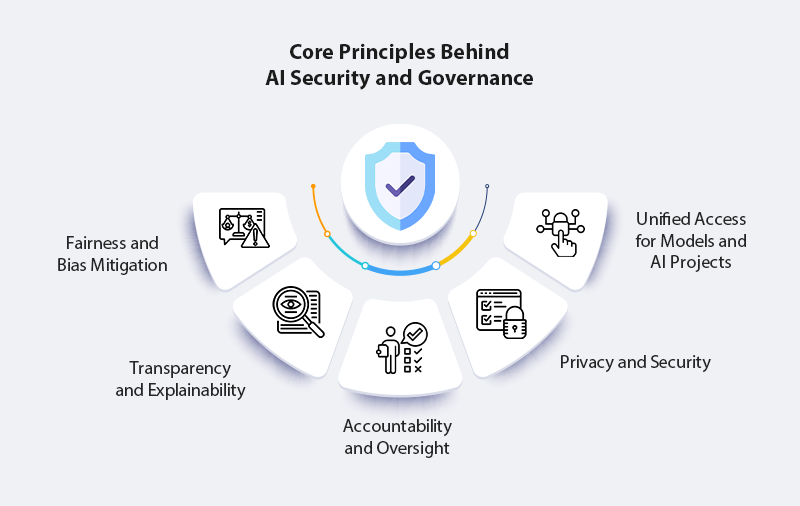
Core Principles Behind AI Security and Governance
AI security and governance frameworks are built on foundational principles that ensure innovation does not come at the cost of trust, compliance, or ethical responsibility. These principles guide how AI systems are designed, deployed, monitored, and scaled across the enterprise.
Fairness and Bias Mitigation
AI systems learn from historical data, and if that data contains bias, models can unintentionally replicate or amplify inequities. In high-impact domains such as lending, hiring, insurance, and healthcare, biased outputs can lead to serious legal and reputational consequences.
AI governance frameworks must therefore integrate fairness testing into the development lifecycle. This includes validating datasets for representativeness, evaluating model outcomes across demographic groups, and conducting periodic reviews to detect emerging bias. Responsible AI requires continuous vigilance, not one-time checks.
Transparency and Explainability
AI decisions should not operate as black boxes. When models influence approvals, risk scores, or customer segmentation, organizations must be able to explain how outcomes were derived.
Transparency enables internal stakeholders, regulators, and customers to understand the logic behind automated decisions. Explainability mechanisms, model documentation, and decision logs ensure that AI outputs are interpretable and defensible. This principle strengthens both compliance readiness and stakeholder confidence.
Accountability and Oversight
AI systems must have clear human accountability structures. Even when automation is advanced, ultimate responsibility cannot rest solely with algorithms.
Governance frameworks define who approves models, who monitors performance, who addresses bias or risk incidents, and who escalates issues to leadership. Structured oversight committees and defined escalation paths ensure AI initiatives align with business strategy and ethical standards.
Privacy and Security
AI systems often process sensitive personal, financial, or proprietary data. Protecting that data is fundamental.
Robust privacy and security controls should cover data ingestion, model training environments, API access, storage infrastructure, and deployment layers. Encryption, access governance, monitoring tools, and secure pipelines safeguard both datasets and models from misuse or cyber threats. Without embedded security, AI systems can quickly become high-value targets for attackers.
Unified Access for Models and AI Projects
As enterprises scale AI across multiple teams, shadow deployments and uncontrolled experimentation can emerge. Separate tools, unmanaged datasets, and unregistered models increase operational risk.
A unified governance structure centralizes visibility and access control. Standardized model registries, role-based permissions, and centralized repositories ensure that every AI initiative operates under consistent policies. This principle reduces fragmentation and strengthens enterprise-wide control.
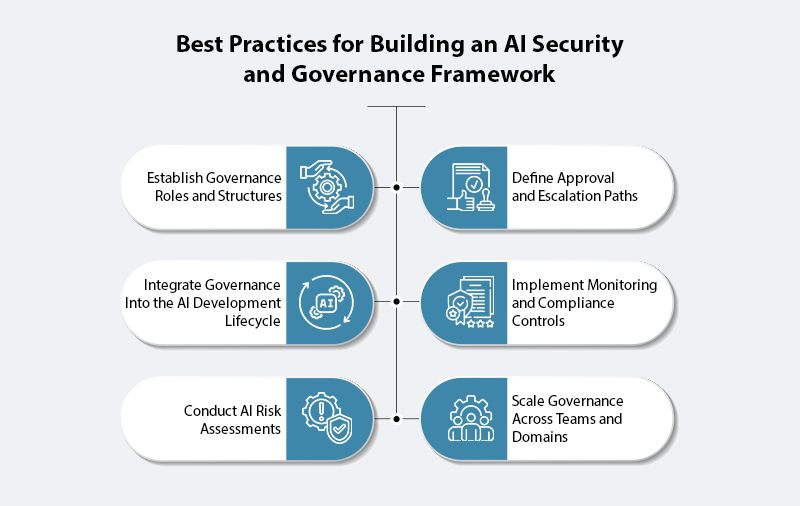
Best Practices for Building an AI Security and Governance Framework
Designing an AI security and governance framework requires more than policies on paper. It demands structured integration of risk controls, accountability, monitoring, and lifecycle management into everyday AI operations. The goal is to enable innovation while maintaining measurable control.
Below are the essential best practices organizations should adopt.
Establish Governance Roles and Structures
A successful framework begins with defined ownership. Organizations should create cross-functional governance bodies that include representatives from IT, security, data science, legal, compliance, and business units.
Clearly defined roles reduce ambiguity around who is responsible for model approvals, risk validation, compliance documentation, and ongoing monitoring. Executive sponsorship also ensures governance is aligned with enterprise strategy rather than treated as a technical afterthought.
Integrate Governance Into the AI Development Lifecycle
Governance should be embedded from the earliest stages of AI development. Risk evaluation, fairness testing, data validation, and documentation must occur during design and training and not after deployment.
By integrating governance checkpoints across data collection, model training, validation, deployment, and monitoring phases, organizations reduce the likelihood of costly rework and regulatory exposure later. Governance becomes proactive rather than reactive.
Conduct AI Risk Assessments
Each AI use case carries a different level of impact and exposure. High-risk systems, such as those influencing financial decisions or healthcare outcomes require deeper scrutiny.
Structured AI risk assessments evaluate ethical risks, bias potential, data sensitivity, cybersecurity exposure, and regulatory implications. Categorizing AI initiatives by risk level allows organizations to apply proportionate controls and approval processes.
Define Approval and Escalation Paths
AI deployments should follow standardized approval protocols. Governance frameworks must define when a model requires review by senior leadership, compliance teams, or risk committees.
Clear escalation mechanisms ensure that critical issues, ethical concerns, or unexpected behavior are addressed promptly. This structure strengthens organizational resilience and reduces delayed responses during incidents.
Implement Monitoring and Compliance Controls
Governance does not end at deployment. AI systems must be continuously monitored for model drift, data anomalies, performance degradation, and emerging bias.
Automated dashboards, audit logs, alert systems, and compliance reporting tools help maintain real-time oversight. These controls ensure that AI systems remain aligned with regulatory and operational expectations over time.
Scale Governance Across Teams and Domains
As AI adoption expands, governance standards must scale without slowing innovation. Standardized templates, documentation frameworks, and policy guidelines enable consistency across departments.
A scalable framework ensures that new AI projects regardless of business function adhere to enterprise-level controls. This prevents fragmentation and supports sustainable AI growth across the organization.

How Espire Ensures AI Security and Governance for Your Business
AI adoption without structured governance exposes businesses to regulatory penalties, reputational damage, operational instability, and data risk. At Espire, AI security and governance are embedded into every AI-led transformation initiative from strategy to deployment and beyond. Our approach balances innovation velocity with enterprise-grade controls to ensure responsible, scalable AI adoption.
Enterprise-Aligned AI Governance Frameworks
Espire designs customized AI governance models aligned with your industry regulations, risk appetite, and digital maturity. We begin with a governance readiness assessment, identifying gaps in ownership, compliance controls, data management, and lifecycle processes.
Our frameworks define clear accountability structures, policy guidelines, AI risk classification models, and compliance mapping to ensure AI initiatives are strategically governed not loosely managed.
Secure AI Lifecycle Management
AI governance must extend across the entire lifecycle. Espire integrates security and validation checkpoints at every stage data ingestion, model development, testing, deployment, and production monitoring.
We ensure controlled development environments, version management, secure API architecture, and role-based access governance. This prevents shadow deployments, model tampering, and unauthorized data exposure while maintaining structured visibility across AI assets.
AI Risk, Bias, and Compliance Assessment
Espire conducts structured AI risk scoring and model validation to identify bias, explainability gaps, data sensitivity exposure, and regulatory conflicts before deployment.
Our governance approach includes fairness testing, impact analysis for high-risk systems, documentation frameworks for audit-readiness, and advisory alignment with emerging AI regulations. This ensures responsible and compliant AI operations from day one.
Continuous Monitoring and Audit Readiness
AI systems evolve, and so should governance controls. Espire implements real-time monitoring dashboards that track performance drift, anomaly behavior, usage activity, and compliance alignment.
We enable enterprises with comprehensive logging and traceability mechanisms that simplify audits and regulatory reporting. This proactive oversight reduces operational surprises and strengthens enterprise resilience.
Unified AI Access and Controlled Ecosystem
As organizations scale AI across functions, fragmented tools and siloed deployments can create blind spots. Espire establishes centralized AI repositories, standardized model registries, and identity-driven access frameworks that provide a unified view of AI assets.
By consolidating governance across teams and platforms, we eliminate uncontrolled experimentation and create a secure, scalable AI ecosystem aligned with enterprise standards.
Conclusion
AI is reshaping industries. But sustainable AI transformation requires more than innovation, it demands responsibility, security, and governance.
Enterprises that invest in AI security today will lead tomorrow with confidence, compliance, and trust.
If your organization is scaling AI initiatives and seeking structured governance, connect with our Security Experts to build a secure, compliant, and future-ready AI ecosystem.