Building Continuity, Compliance, and Resilience Through ERP, CRM, WMS, and Secure APIs
Global supply chains are becoming hyperconnected digital ecosystems. According to Markets and Markets, the global supply chain management market was valued at over $38.51 billion in 2025 and is projected to grow at a CAGR of more than 8.7% through 2030. Meanwhile, Gartner reports that over 75% of large enterprises are accelerating API-led integration strategies to enable real-time supply chain visibility and automation.
However, as ERP, CRM, and WMS platforms become tightly integrated across geographies, partner networks, and cloud environments, the attack surface expands. Logistics enterprises are now managing thousands of APIs, multiple identity layers, partner integrations, and regulatory mandates across regions.
The challenge is no longer just digital transformation. It is secure and scalable transformation.
To maintain operational continuity, ensure regulatory compliance, and enable resilient global logistics, organizations must combine deep platform integration with robust API security and identity governance frameworks.
Role of ERP, CRM, and WMS in Modern Logistics
Enterprise platforms form the digital backbone of connected supply chains. When integrated effectively, they eliminate silos and create end-to-end visibility.
ERP as the Core Operational System
ERP platforms centralize finance, procurement, inventory management, order processing, and cross-border transactions. They ensure synchronized planning, billing, compliance documentation, and operational control across global warehouses and distribution hubs.
CRM for Real-Time Customer Visibility
CRM systems enable logistics providers to manage contracts, SLAs, shipment tracking, communication touchpoints, and service workflows. They connect customer expectations directly to supply chain execution.
WMS for Warehouse Precision and Automation
Warehouse Management Systems optimize picking, packing, inventory reconciliation, yard management, and smart storage. Advanced WMS solutions integrate with IoT and automation tools to enable predictive operations.
Integration Enables Unified Decision-Making
When ERP, CRM, and WMS platforms operate in silos, delays and discrepancies occur. Integrated systems provide a single source of truth across operations, improving accuracy and reducing manual intervention.
Digital Platforms Drive Agility at Scale
Integrated enterprise applications enable demand forecasting, multi-node inventory planning, route optimization, and partner collaboration essential for managing global logistics complexity.
Why API Security and Identity Management Are Critical in Logistics Operations
As logistics enterprises become increasingly connected, APIs now power every critical transaction across ERP, CRM, WMS, customs platforms, partner systems, and customer portals. They enable real-time visibility, automation, and cross-border collaboration. However, this connectivity also expands the organization’s risk exposure.
In global logistics, security is directly tied to operational continuity. A single vulnerability in an API or identity layer can disrupt shipments, delay billing, or compromise sensitive trade and customer data. This makes API security and identity governance fundamental business priorities rather than secondary IT concerns.
APIs Are Strategic Entry Points
APIs act as digital gateways between internal systems and external ecosystems. Without strong authentication, encryption, and monitoring controls, they become attractive targets for cyberattacks. Securing APIs ensures that data flowing between ERP, CRM, WMS, and partner platforms remains protected and uninterrupted.
Expanding Partner Networks Increase Risk
Logistics organizations integrate with freight forwarders, carriers, customs authorities, suppliers, and financial institutions. Each integration introduces new access credentials and data exchange channels. Without centralized governance, managing secure access across such distributed environments becomes complex and risky.
Identity Governance Prevents Access Misuse
Thousands of users, third parties, and automated systems interact with logistics platforms daily. Strong Identity and Access Management ensures users have role-based access aligned with responsibilities, reducing insider threats and unauthorized activity while maintaining operational efficiency.
Compliance Requires Traceable Access
Global regulations demand transparency, auditability, and controlled data access. Secure APIs and structured identity management frameworks provide the traceability needed to demonstrate compliance across jurisdictions.
Cyber Incidents Disrupt Physical Operations
In logistics, cybersecurity breaches impact not just data but physical movement of goods. Compromised access can halt warehouse systems, delay customs processes, and interrupt revenue cycles. Protecting APIs and identities is therefore essential to maintaining uninterrupted supply chain operations.
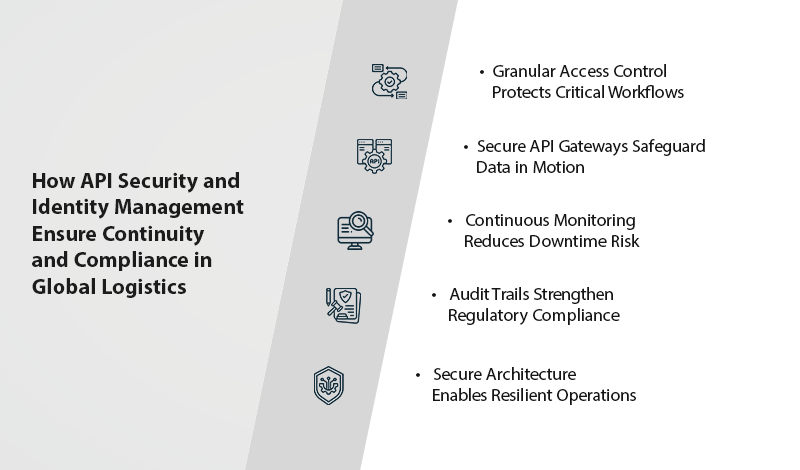
How API Security and Identity Management Ensure Continuity and Compliance in Global Logistics
In global logistics, continuity and compliance are inseparable. Shipments move across borders, warehouses operate 24/7, financial transactions span multiple currencies, and sensitive trade data flows through interconnected systems. In such an environment, disruptions or compliance failures can create cascading operational and reputational damage. Robust API security and identity management frameworks act as the control layer that protects this interconnected ecosystem while ensuring uninterrupted operations.
Granular Access Control Protects Critical Workflows
Identity governance ensures that employees, partners, vendors, and automated systems access only what they are authorized to use. Role-based access controls and multi-factor authentication reduce the risk of unauthorized activity while maintaining smooth operational workflows. When access is tightly governed, organizations minimize insider risks without slowing down execution.
Secure API Gateways Safeguard Data in Motion
Every interaction between ERP, CRM, WMS, and third-party platforms passes through APIs. Secure API gateways enforce authentication protocols, validate tokens, encrypt data transmissions, and monitor unusual behavior in real time. This protection ensures that shipment data, financial records, and customer information move securely across systems without compromising performance.
Continuous Monitoring Reduces Downtime Risk
Advanced security monitoring tools identify anomalies, suspicious login attempts, unusual API traffic, and potential threat patterns before they escalate. Early detection prevents small vulnerabilities from turning into operational shutdowns. In logistics, proactive monitoring directly supports uptime and service reliability.
Audit Trails Strengthen Regulatory Compliance
Strong identity frameworks generate detailed access logs and transaction records. These audit trails provide traceability for every data exchange and system interaction. Such visibility simplifies regulatory reporting, reduces audit stress, and ensures compliance with international data protection and information security standards.
Secure Architecture Enables Resilient Operations
Modern API security frameworks are evolving beyond traditional controls by combining federated identity with AI-driven Dynamic Zero Trust models. In this approach, access decisions are made in real time based on behavioral context rather than static credentials alone. While federation manages and validates access across distributed ecosystems, AI continuously monitors activity, detects anomalies, and prevents misuse enabling logistics enterprises to scale securely without compromising continuity.
How Espire Helps Logistics Players Ensure Seamless API Security
In global logistics, digital transformation must be secure by design. Integrating ERP, CRM, WMS, and partner ecosystems without a structured security framework can create hidden vulnerabilities. Espire approaches API security not as an afterthought, but as a foundational layer within enterprise application modernization. By combining system integration expertise with governance-led security frameworks, Espire helps logistics enterprises scale confidently while protecting operational continuity.
Secure-by-Design Application Modernisation
Espire modernizes legacy ERP, CRM, and WMS platforms into cloud-ready, API-driven architectures with embedded security controls. From architecture design to deployment, security principles such as Zero Trust, encryption standards, and controlled API exposure are integrated at every stage.
Enterprise-Grade API Management Frameworks
Espire implements structured API management models that include secure gateways, token-based authentication, traffic monitoring, and lifecycle governance. APIs are catalogued, version-controlled, and continuously monitored to prevent misuse or unauthorized access. This structured governance ensures consistency and scalability across growing logistics ecosystems.
Robust Identity and Access Management (IAM)
Managing thousands of users, third-party partners, and automated systems requires disciplined identity governance. Espire deploys centralized Identity and Access Management frameworks with role-based access control, multi-factor authentication, and federated identity models. This approach ensures that access is precise, traceable, and aligned with regulatory expectations.
Secure Multi-System Integration
Espire connects ERP, CRM, WMS, and external platforms through secure middleware and microservices architectures. By enforcing encryption, validation protocols, and real-time monitoring across integrations, data flows remain protected without sacrificing performance. The result is seamless interoperability backed by strong security controls.
Governance and Compliance Alignment
Beyond technical implementation, Espire helps organizations establish security governance frameworks aligned with global compliance standards. Access audits, policy standardization, risk assessments, and continuous monitoring processes are built into operational workflows. This ensures that security evolves in parallel with business growth and regulatory demands.
Conclusion
In today’s global logistics landscape, connected supply chains cannot function without secure and scalable enterprise applications. ERP, CRM, and WMS integration delivers visibility and efficiency but only when reinforced with robust API security and identity governance.
Security is no longer a backend IT function. It is a strategic enabler of continuity, compliance, and resilience.
Organizations that embed secure application modernization into their supply chain roadmap position themselves to scale confidently, collaborate securely, and operate without interruption across geographies.
Ready to secure and future-proof your supply chain ecosystem?
Connect with our experts to explore how Espire can help you build agile, compliant, and resilient logistics platforms powered by secure integration.