AI in Insurance: Why, When, and How It Impacts the Business
Artificial Intelligence has quietly moved past the experimentation phase in insurance. Today, it’s becoming a very real differentiator in how insurers operate, compete, and scale. Whether it’s reducing operational friction in the back office or reshaping how customers experience claims and service, AI is increasingly part of how insurers respond to rising expectations, margin pressure, and complexity.
Key AI Trends Reshaping Insurance in 2025–2026
- Generative and Agentic AI are transitioning from pilot projects into mainstream operations, automating complex tasks like claims assessment and underwriting review with reduced human intervention.
- Embedded and AI-enabled products are rising, particularly in fintech and adjacent sectors, reflecting insurers’ push to offer context-aware coverage.
- Personalized pricing and risk insights are being powered by advanced analytics, enabling insurers to offer tailored solutions at scale.
- AI adoption still has room to scale, with many insurers experimenting but only a small percentage having integrated AI across the enterprise.
Why AI Is Necessary in Insurance
The insurance industry is at a structural inflection point. Rising claim volumes, volatile risk environments, digitally native customers, and intensifying regulatory scrutiny are exposing the limitations of traditional insurance models. AI is no longer an efficiency lever it has become a strategic necessity for insurers looking to stay relevant, resilient, and profitable.
Below are the core challenges driving the need for AI in insurance, explained in depth.
Legacy-Driven Operational Inefficiencies
Most insurers still operate on legacy systems and manual workflows built for a slower, more predictable era. Underwriting often involves repetitive data entry, claims processing depends heavily on human review, and policy servicing is fragmented across systems.
This results in:
- Longer turnaround times
- High operational costs
- Inconsistent decision-making
AI transforms these operations by automating data ingestion, validating inputs, and accelerating decision cycles. Tasks that once took days like risk evaluation or claim triage can now be completed in minutes, allowing insurers to operate at digital speed without replacing core systems overnight.
Escalating Customer Expectations and Experience Gaps
Today’s policyholders compare insurers not just with competitors, but with digital leaders across banking, e-commerce, and fintech. They expect:
- Instant responses
- Seamless omnichannel interactions
- Personalized products and communications
Traditional contact centers and static workflows struggle to meet these expectations. AI-powered virtual assistants, intelligent routing, and personalization engines enable insurers to deliver real-time, contextual, and consistent experiences without exponentially increasing service costs. AI helps close the growing gap between what customers expect and what insurers can realistically deliver at scale.
Increasing Fraud Sophistication and Risk Complexity
Insurance fraud has evolved beyond simple false claims into complex, coordinated schemes involving synthetic identities, staged incidents, and cross-channel manipulation. Rule-based fraud detection systems are often reactive and limited to known patterns.
AI enables a proactive approach by:
- Learning from historical and real-time data
- Detecting anomalies and hidden correlations
- Adapting to new fraud tactics as they emerge
By continuously improving detection accuracy, AI reduces false positives, prevents revenue leakage, and strengthens trust across the insurance ecosystem.
Margin Pressure from Economic, Climate, and Regulatory Forces
- Insurers face shrinking margins due to:
- Rising claim costs (natural catastrophes, healthcare inflation, cyber risks)
- Regulatory compliance overhead
- Increased competition from insurtechs and embedded insurance models
AI helps insurers protect and improve margins by optimizing pricing, reducing leakage, improving loss ratios, and lowering operational costs. More importantly, AI enables dynamic decisioning, allowing insurers to adapt pricing, coverage, and capital allocation in response to changing risk conditions rather than relying on static models.
Data Abundance Without Actionable Intelligence
Insurers are sitting on vast volumes of structured and unstructured data, from policy records and claims documents to call transcripts, images, IoT feeds, and third-party data sources.
The challenge isn’t data availability, it’s turning data into decisions.
AI bridges this gap by:
- Extracting insights from unstructured data using NLP and computer vision
- Identifying patterns humans would miss
- Enabling predictive and prescriptive analytics
This allows insurers to move from hindsight-based reporting to foresight-driven decision-making anticipating risks, customer needs, and market shifts before they fully materialize.
When AI Is Useful in the Insurance Industry
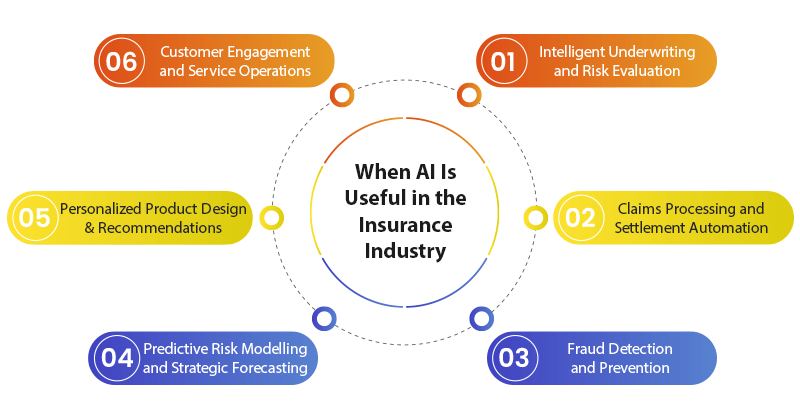
AI delivers the most value in insurance when decisions must be made quickly, at scale, and with a high degree of accuracy often across complex data sets and unpredictable risk scenarios. Rather than being limited to a single function, AI becomes most effective when embedded across the insurance value chain, supporting moments where speed, intelligence, and consistency directly influence business outcomes.
Below are the key situations and use cases where AI proves indispensable for insurers, explained in detail.
Intelligent Underwriting and Risk Evaluation
AI is especially useful at the underwriting stage, where insurers must assess risk accurately while maintaining speed and competitiveness. Traditional underwriting depends on predefined rules and limited data sources, which often leads to conservative pricing or prolonged processing cycles.
AI-driven underwriting models analyse structured and unstructured data such as historical claims, customer behaviour, external risk indicators, and third-party datasets to generate more nuanced risk profiles. This allows insurers to:
- Shorten underwriting cycle times
- Improve pricing accuracy
- Expand coverage to new or under-served segments
The result is faster policy issuance without compromising risk discipline.
Claims Processing and Settlement Automation
Claims represent the most operationally intensive and emotionally sensitive phase of the insurance lifecycle. AI becomes crucial when claims volumes surge such as during natural disasters, health crises, or large-scale incidents.
By using document intelligence, computer vision, and machine learning, AI helps:
- Automatically extract information from claim documents
- Assess damage from images and videos
- Route complex claims to human experts while settling simple ones instantly
This reduces claim turnaround time, lowers processing costs, and significantly improves claimant satisfaction.
Fraud Detection and Prevention
AI is most valuable in fraud detection when insurers need to identify suspicious activity early before financial losses escalate. Unlike static rule engines, AI continuously learns from evolving patterns across claims, policies, payments, and customer behaviour.
AI models detect subtle inconsistencies and relationships that may signal fraud, even when no predefined rules are violated. This allows insurers to take preventive action, reduce investigation workloads, and protect genuine customers from delays caused by over-cautious checks.
Customer Engagement and Service Operations
AI is particularly useful when insurers aim to scale customer service without scaling costs. With rising customer demand for 24/7 support, AI-powered chatbots and virtual assistants handle routine queries such as policy status, renewals, endorsements, and claims updates.
More advanced conversational AI goes a step further by understanding intent, sentiment, and context—allowing seamless handoffs to human agents when needed. This ensures consistent service quality while freeing human teams to focus on complex and high-value interactions.
Personalized Product Design and Recommendations
AI plays a critical role when insurers want to move beyond one-size-fits-all products. Using behavioural data, risk indicators, and customer preferences, AI enables insurers to design and recommend personalized coverage, pricing, and add-ons.
This is particularly useful in:
- Usage-based and on-demand insurance
- Microinsurance models
- Cross-sell and up-sell scenarios
Personalization powered by AI improves conversion rates, customer relevance, and lifetime value while reducing churn.
Predictive Risk Modelling and Strategic Forecasting
AI becomes indispensable when insurers need to anticipate future risks rather than react to past events. Predictive analytics powered by AI helps insurers forecast claim frequency, severity trends, lapse behaviour, and portfolio performance.
By simulating future scenarios such as climate impacts, economic shifts, or demographic changes AI supports better capital planning, reinsurance strategies, and product innovation. This foresight enables insurers to make proactive, data-driven decisions in an increasingly uncertain environment.
How AI Helps the Insurance Industry
AI helps insurers move from reactive operations to intelligent, adaptive, and insight-driven enterprises. Its impact goes beyond automation, AI reshapes how insurers assess risk, serve customers, control costs, and make strategic decisions. When embedded thoughtfully across the value chain, AI delivers measurable improvements across efficiency, experience, and profitability.
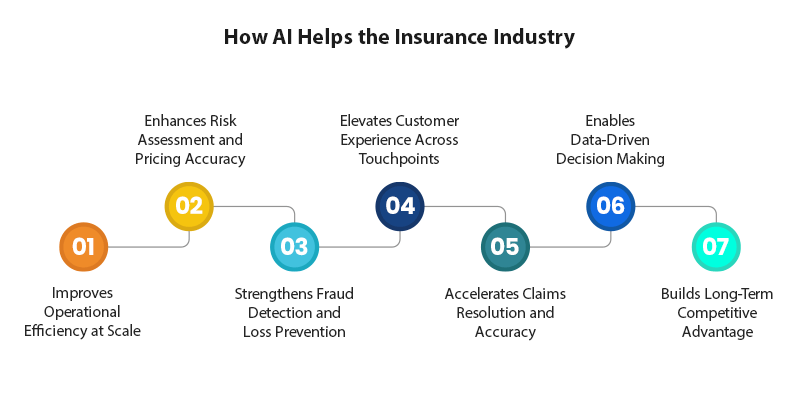
Below are the keyways AI helps the insurance industry, explained in depth.
Improves Operational Efficiency at Scale
AI reduces dependency on manual, repetitive tasks that slow down insurance operations. Activities such as data entry, document verification, policy issuance, and claims validation are streamlined through intelligent automation.
By processing high volumes of transactions with consistent accuracy, AI enables insurers to handle growth without proportionally increasing operational costs. This scalability is especially valuable during peak periods such as renewals, catastrophe events, or regulatory reporting cycles.
Enhances Risk Assessment and Pricing Accuracy
Traditional actuarial models rely on historical data and static assumptions. AI enhances these models by incorporating real-time data and uncovering complex, non-linear patterns that humans and conventional systems may miss.
Machine learning enables:
- More granular risk segmentation
- Dynamic pricing adjustments
- Improved loss ratios
As a result, insurers can price products more fairly and competitively while maintaining underwriting discipline.
Strengthens Fraud Detection and Loss Prevention
AI helps insurers reduce financial leakage by identifying potential fraud earlier and with higher precision. Instead of reacting after losses occur, AI proactively flags anomalies across claims, policies, and customer behaviour.
By minimizing false positives, AI shortens investigation cycles and prevents unnecessary friction for legitimate customers balancing security with customer trust.
Elevates Customer Experience Across Touchpoints
AI-powered personalization and conversational interfaces help insurers engage customers in a more timely and relevant way. Customers receive faster responses, clearer communication, and tailored recommendations based on their needs and life events.
From onboarding and renewals to claims updates, AI ensures consistency across channels while improving satisfaction and retention without placing additional burden on service teams.
Accelerates Claims Resolution and Accuracy
Claims processing benefits significantly from AI through automated document analysis, damage assessment using images or videos, and intelligent triaging.
This leads to:
- Faster claim settlements
- Reduced disputes
- Improved transparency for policyholders
By resolving straightforward claims quickly and escalating complex ones intelligently, AI helps insurers balance speed with accuracy and empathy.
Enables Data-Driven Decision Making
AI helps insurers unlock the full value of their data by transforming raw information into actionable insights. Predictive and prescriptive analytics support strategic decisions such as portfolio optimization, product innovation, and market expansion.
Leadership teams gain clearer visibility into trends, risks, and opportunities enabling more confident and timely decisions in an increasingly volatile environment.
Builds Long-Term Competitive Advantage
Insurers that embed AI across core functions outperform peers in agility, cost efficiency, and customer relevance. AI allows organizations to innovate faster, adapt to market shifts, and respond to emerging risks with greater confidence.
Over time, this creates a sustainable competitive advantage where insurers are not just responding to change, but shaping the future of insurance itself.

How Espire AI-Powered Solutions Help Insurance Businesses
Espire approaches AI in insurance not as a standalone technology rollout, but as a business transformation enabler. The focus is on embedding AI where it creates measurable impact improving decision quality, accelerating operations, strengthening compliance, and enhancing customer trust. Espire’s AI-powered solutions are designed to work with existing insurance ecosystems while gradually modernizing them for scale and intelligence.
Below is how Espire helps insurance businesses unlock real value from AI.
AI-Enabled Underwriting for Faster, Smarter Decisions
Espire helps insurers modernize underwriting by integrating AI models that analyse both traditional and alternative data sources. Instead of relying solely on static rules and historical averages, underwriting becomes more dynamic, and contextual.
AI-driven insights enable underwriters to:
- Assess risks more accurately
- Reduce manual review efforts
- Issue policies faster without compromising risk controls
This results in improved turnaround times, better pricing precision, and the ability to underwrite complex or non-standard risks with confidence.
Intelligent Claims Automation with Human-in-the-Loop Control
Claims efficiency is a major lever for both customer satisfaction and cost optimization. Espire deploys AI-powered document intelligence, image analysis, and workflow automation to streamline claims intake, validation, and settlement.
At the same time, Espire ensures human-in-the-loop governance, where AI supports (not replaces) human judgment in complex or sensitive claims. This balances speed, accuracy, and empathy, helping insurers deliver faster resolutions while maintaining trust and regulatory compliance.
Advanced Fraud Detection and Risk Monitoring
Espire enables insurers to move from reactive fraud investigation to proactive fraud prevention. By applying machine learning and behavioural analytics, Espire’s solutions continuously monitor transactions, claims patterns, and customer activities.
These AI models adapt over time, identifying emerging fraud patterns such as synthetic identities or coordinated fraud rings. The outcome is reduced false positives, lower fraud losses, and more efficient investigation processes without disrupting genuine customer journeys.
AI-Driven Customer Engagement and Personalization
Espire helps insurers elevate customer engagement through AI-powered conversational platforms and personalization engines. From onboarding and renewals to policy servicing and claims updates, customers receive timely, context-aware interactions across channels.
These solutions improve:
- Responsiveness and service consistency
- Personalization of offers and communication
- Customer retention and lifetime value
Responsible, Scalable AI with Built-In Governance
Espire places strong emphasis on responsible AI adoption critical in a highly regulated industry like insurance. AI solutions are designed with transparency, explainability, data security, and compliance at the core.
Espire helps insurers:
- Govern AI models responsibly
- Maintain auditability and regulatory alignment
- Scale AI adoption confidently across functions
This ensures insurers can innovate with AI while protecting brand trust, customer data, and regulatory standing.
Conclusion
From reducing friction in core operations to enabling personalized experiences and smarter risk strategies, the impact of AI is transformative and measurable.
If your insurance business is still contemplating AI, the time to act is now. Harness the power of intelligent automation and predictive insights connect with Espire to unlock growth, agility, and unparalleled customer value in the age of AI.