AI in Healthcare: Unlocking Precision, Speed, and Intelligence with Multi-Agent Medical Records AI
The healthcare industry stands on the verge of a transformation—one driven not just by digital adoption, but by intelligent automation that can read, understand, and act on complex medical data. With Electronic Health Records (EHRs), imaging archives, claim documents, and clinical notes growing exponentially, healthcare teams are overwhelmed with information that is critical but difficult to process manually.
This is where AI specifically Medical Records Intelligence powered by multi-agent systems is reshaping the future of care delivery.
Imagine a coordinated group of AI agents working together, each specializing in a different part of the medical evaluation process. They don't just store or analyze data; they perform tasks that traditionally required clinical, administrative, and risk-assessment expertise.
Let’s explore how this works.
What Is Medical Records Intelligence?
Medical Records Intelligence is an emerging class of AI designed to interpret, analyze, and audit medical information with the precision of multiple domain experts. Instead of relying on a single model, it uses a multi-agent architecture, where each agent focuses on a specific responsibility, such as:
Reads Medical Documents
Using Natural Language Processing (NLP), the system extracts structured insights from physician notes, discharge summaries, diagnostic reports, lab records, and claim documents. It understands context, medical terminology, and clinical relationships that traditional OCR tools miss.
Classifies Injuries
ML-powered classification models identify injury types, severity levels, and related clinical factors critical for claims processing, underwriting, and care management.
Calculates Reserves
AI agents use historical data and predictive models to estimate financial reserves required for medical claims or future treatments helping insurers and healthcare payers improve accuracy and reduce leakage.
Assesses Risk
Machine Learning evaluates comorbidities, treatment pathways, and historical patterns to derive real-time risk scores for patients, claims, or clinical scenarios.
Flags Anomalies
AI agents detect inconsistencies, abnormal patterns, missing information, or suspicious data supporting fraud detection and clinical accuracy.
Audits Medical Report Quality
The system reviews wording quality, documentation completeness, and compliance with clinical or regulatory standards, ensuring cleaner, more dependable medical records.
At its core, Medical Records Intelligence is the perfect junction of Machine Learning (pattern recognition, prediction) and Natural Language Processing (language understanding, summarization, context extraction). It enhances clinical decision-making, speeds up administrative work, and reduces human burden without replacing clinical expertise.
The Role of Machine Learning and NLP in Modern Healthcare
Machine Learning: Turning Clinical Data into Predictive Intelligence
Machine Learning (ML) has become one of the most transformative forces in healthcare, primarily because of its ability to recognize patterns that are either too subtle or too complex for humans to detect. Every patient generates a trail of clinical data from vitals and lab records to imaging, prescriptions, and long-term outcomes. ML models learn from this growing pool of information to make accurate predictions, automate decisions, and support clinicians in real time.
For example, ML algorithms can analyze thousands of historical heart failure cases to estimate a patient’s risk of readmission within 30 days, or examine oncology treatment pathways to suggest which therapies are likely to work best based on individual clinical histories.
Beyond diagnosis and prognosis, ML optimizes operational workflows predicting patient inflow, identifying fraud in claims, reducing waiting times, and enhancing resource allocation across hospitals and care networks. It effectively turns healthcare systems from reactive responders into proactive planners.
Natural Language Processing: Making Sense of Unstructured Medical Text
On the other hand, Natural Language Processing (NLP) is tackling one of the industry’s biggest challenges the overwhelming volume of unstructured medical text. More than 80% of healthcare data lives in free-form documents such as physician notes, discharge summaries, radiology interpretations, research reports, and insurance claim narratives.
NLP makes this unstructured content understandable and usable by identifying medical entities, summarizing long records, extracting diagnoses, and even interpreting clinical sentiment. With NLP, tasks that previously consumed hours like reading a patient’s complete medical history can be done in seconds, enabling clinicians to make quicker, more informed decisions.
Modern NLP models can also interpret context and clinical intent, distinguishing between similar but clinically different expressions such as “rule out pneumonia” versus “confirmed pneumonia.” This capability powers AI-assisted documentation, smart EHR search, automated coding, decision support tools, and conversational AI systems that help with triage and patient engagement.
ML + NLP Together: Powering the Future of Intelligent Healthcare
Together, Machine Learning and NLP form the backbone of intelligent healthcare automation. ML delivers predictive and analytical power, while NLP unlocks the context-rich narratives behind every patient case. Combined, they enable a level of speed, accuracy, and personalization that was previously impossible ensuring that care providers can deliver better outcomes while reducing administrative burden and operational complexity.
Applications of Generative AI in Healthcare
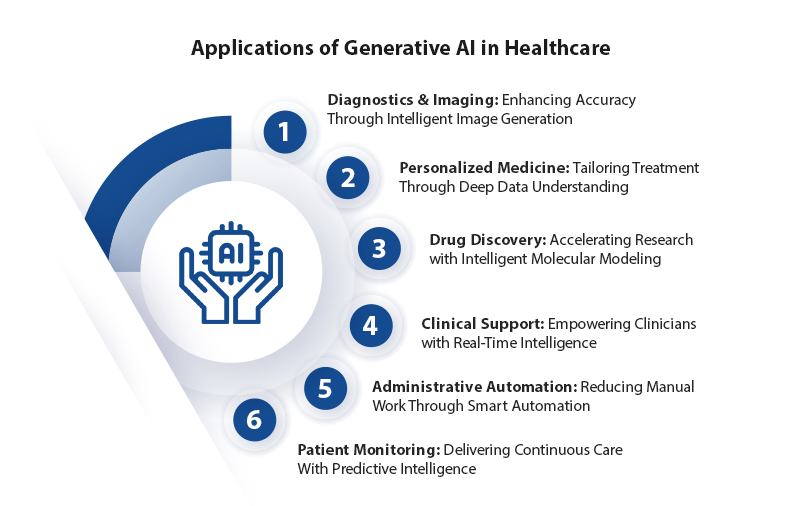
Diagnostics & Imaging: Enhancing Accuracy Through Intelligent Image Generation
Generative AI is redefining medical imaging by enabling systems to learn from existing scans and generate entirely new, high-fidelity synthetic images. These synthetic datasets help train diagnostic models without compromising patient privacy or relying solely on limited real-world samples.
More importantly, GenAI enhances blurry or incomplete scans by reconstructing missing details, improving contrast, or sharpening subtle visual cues that radiologists might otherwise miss. This leads to earlier detection of cancerous nodules, microfractures, vascular irregularities, and neurological anomalies. By serving as a second set of highly trained eyes, Generative AI significantly improves diagnostic accuracy and reduces the rate of misinterpretation.
Personalized Medicine: Tailoring Treatment Through Deep Data Understanding
Healthcare is shifting away from generalized treatment pathways toward personalized care, and Generative AI is accelerating that transition. By analyzing massive datasets including genomics, lifestyle factors, EHRs, historical outcomes, and even wearable device signals GenAI builds a complete and dynamic profile of each patient.
This enables healthcare systems to design individual treatment plans, optimize medication dosages, predict disease progression, and identify at-risk patients long before symptoms appear. From oncology to chronic disease management, Generative AI ensures patients receive interventions uniquely tailored to their biology and lifestyle.
Drug Discovery: Accelerating Research with Intelligent Molecular Modeling
Traditional drug discovery is time-intensive, expensive, and often limited by the complexity of biological interactions. Generative AI models simulate how proteins, molecules, and drugs behave in the human body, enabling researchers to test thousands of interactions in hours instead of years.
GenAI can predict toxicity levels, generate new molecular structures, and identify the most promising drug candidates early in the pipeline. It reduces trial-and-error experimentation and helps pharma companies cut development timelines dramatically. This means faster development of life-saving drugs, especially for rare diseases where historical data is limited.
Clinical Support: Empowering Clinicians With Real-Time Intelligence
In high-pressure clinical environments, GenAI functions as a real-time support layer for physicians, nurses, and care managers. It analyzes patient data, suggests treatment options, flags potential drug interactions, and assists doctors in drafting care plans.
Instead of manually sifting through charts or guidelines, clinicians get a contextual summary of the most relevant information at the point of care. This improves both the speed and quality of decision-making while reducing cognitive burden and documentation fatigue.
Administrative Automation: Reducing Manual Work Through Smart Automation
Beyond clinical operations, Generative AI contributes significantly to administrative efficiency. AI-powered chatbots manage patient scheduling, handle appointment reminders, and triage symptoms before they reach clinicians. GenAI also automates medical documentation, turning voice notes or long consultations into structured summaries for EHR entry.
In the payer ecosystem, AI assists with claims analysis, eligibility checks, and error detection reducing processing time and cutting administrative costs. Every automated workflow frees up time for healthcare staff to focus on patient care instead of paperwork.
Patient Monitoring: Delivering Continuous Care With Predictive Intelligence
With the rise of wearables and remote patient monitoring devices, healthcare providers can now access continuous streams of real-time patient data. Generative AI analyzes patterns in heart rate, blood oxygen levels, sleep cycles, glucose readings, and physical activity to detect early warning signs of deterioration.
Whether it’s predicting a diabetic episode or alerting clinicians to unusual cardiac rhythms, GenAI enables early intervention and supports proactive, preventive care. This is particularly transformative for elderly patients, chronic disease management, and remote care models.

How Espire’s GenAI Services Are Helping Healthcare Businesses
Espire is enabling hospitals, insurers, and healthcare providers to move confidently into the future with end-to-end GenAI-driven solutions built on real-world expertise.
Predictive Analytics Solutions
We help healthcare teams forecast disease risks, patient volumes, claim outcomes, treatment success likelihood, and operational bottlenecks using advanced ML and GenAI models.
Medical Imaging Solutions
Espire’s AI-powered imaging tools enhance scan clarity, detect anomalies, and automate image analysis for faster, more accurate diagnostics.
Mining EHRs for Actionable Insights
Our NLP-driven platforms extract structured insights from massive EHR datasets transforming clinician notes, lab reports, prescriptions, and historical data into intelligence for decision-making.
AI-Enabled Chatbots for Patient & Provider Support
We build conversational assistants that handle scheduling, triage, report retrieval, symptom queries, discharge instructions, and more reducing admin load and improving patient experience.
AI-Driven Automation for Productivity & Compliance
Espire automates key workflows such as claims processing, clinical documentation, compliance reporting, prior authorization, and records summarization helping healthcare organizations operate with speed, accuracy, and reduced costs.
Conclusion
AI in healthcare is not just an efficiency tool it is rapidly becoming a critical partner in clinical decision-making, administrative excellence, and patient empowerment. Multi-agent Medical Records Intelligence, combined with ML, NLP, and Generative AI, is reshaping how healthcare organizations read, interpret, and act upon medical data.
Healthcare systems that embrace this shift will deliver faster diagnoses, personalized care, lower operational costs, and better patient outcomes.
If you’re ready to explore how GenAI can revolutionize your healthcare workflows, operations, and patient experience, Espire is here to guide your journey.
Get in touch with our healthcare transformation experts today.