AI in First Notice of Loss: How Travel Insurance Enhances its Efficiency with Automation
In travel insurance, the First Notice of Loss (FNOL) marks the beginning of a customer’s claims journey, it’s that crucial moment when a traveller reports a mishap, from lost luggage to a medical emergency abroad. Traditionally, this process involved endless forms, manual data entry, and back-and-forth phone calls, often leaving both customers and insurers frustrated with delays and inaccuracies.
But things are changing fast. With the power of Artificial Intelligence (AI), insurers are reimagining FNOL, making it faster, smarter, and more seamless. AI technologies like Machine Learning (ML), Natural Language Processing (NLP), and predictive analytics are automating what used to be tedious manual tasks. They can instantly capture claim details, detect missing information, and even anticipate potential fraud, allowing insurers to focus more on service rather than paperwork.
Understanding First Notice of Loss (FNOL)
The First Notice of Loss (FNOL) is the very first step a policyholder takes after experiencing an unexpected event covered by their insurance policy for instance, a cancelled flight, lost baggage, or a medical emergency during travel. It’s the moment when the insured notifies the insurance company about the incident, triggering the claims process.
In simpler terms, FNOL serves as the insurer’s first opportunity to gather crucial details about what happened, assess the situation, and start working on the claim. Traditionally, this involved customers filling out forms, making phone calls, and sharing documents manually - a process that often led to delays, missing data, and inconsistent communication.
Today, with digital tools and AI-driven automation entering the picture, FNOL is evolving into a faster, more accurate, and customer-friendly experience. By reducing manual intervention and ensuring timely, error-free reporting, AI is helping insurers turn what was once a tedious process into a seamless start to the customer’s claim journey.
The Role of AI in Transforming FNOL: From Data to Decisions
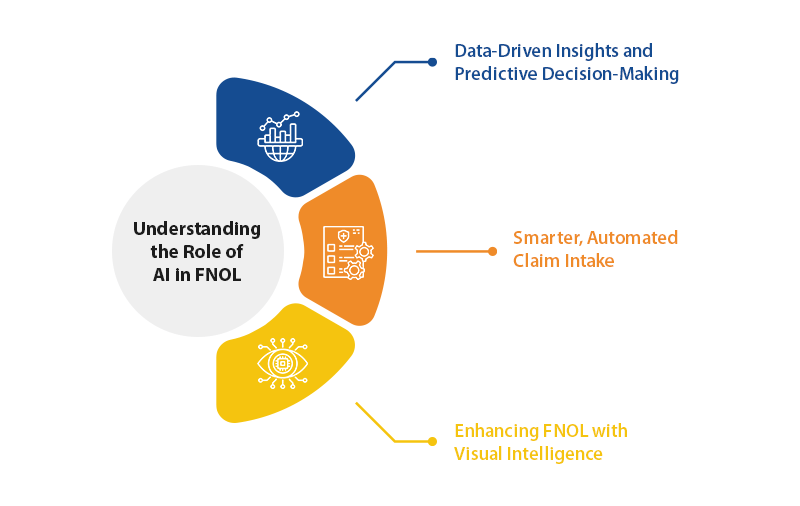
Artificial Intelligence is reshaping how travel insurers manage First Notice of Loss (FNOL) -turning what was once a reactive process into a proactive, data-driven operation. By combining data analysis, prediction, and intelligent automation, AI empowers insurers to make faster, more accurate decisions from the very first customer interaction.
Data-Driven Insights and Predictive Decision-Making
AI enables insurers to rapidly analyze massive volumes of data from historical claims and policy records to external factors like weather patterns, regional events, or travel disruptions. This real-time data processing helps insurers identify trends, detect anomalies, and make quicker, more informed decisions. With machine learning models, insurers can even anticipate claims patterns, forecast potential risks, and plan resource allocation ahead of time. This proactive approach not only speeds up the claims process but also helps optimize premiums and strengthen risk mitigation strategies.
Smarter, Automated Claim Intake
The initial claim reporting stage has traditionally been time-consuming, often requiring extensive manual input. AI changes this through Natural Language Processing (NLP), which enables systems to interpret unstructured text from emails, chat messages, or claim forms. NLP can extract key details such as location, incident type, and loss description — with remarkable accuracy, reducing the need for manual review. Intelligent chatbots further enhance the FNOL experience by guiding policyholders through the process, answering questions instantly, and ensuring smooth, consistent communication.
Enhancing FNOL with Visual Intelligence
AI doesn’t stop at data or text it’s also transforming visual claim assessments. Using AI-powered image and video analysis, travel insurers can evaluate the extent of damage or verify supporting evidence directly from customer submissions. This not only accelerates the validation process but also improves the accuracy of assessments, reducing disputes and enabling faster settlements.
Overcoming Implementation Challenges of AI in FNOL Automation
While the benefits of AI-driven FNOL automation in travel insurance are undeniable, implementing these systems comes with its own set of challenges. From data readiness to system integration and user adoption, insurers often face hurdles that can slow down or complicate the transformation journey. However, with the right strategy and approach, these challenges can be effectively overcome to ensure smooth, scalable, and impactful implementation.
Data Quality and Integration Issues
One of the biggest challenges in adopting AI for FNOL is the lack of high-quality, structured data. Travel insurance data often resides in silos across multiple legacy systems, making it difficult to consolidate and analyze effectively.
Solution:
Insurers can begin by implementing data cleansing, normalization, and integration frameworks that unify data from various touchpoints such as CRM systems, policy databases, and customer communication platforms. Leveraging data lakes and APIs can further ensure seamless data flow between systems, providing AI models with the consistent and accurate data they need to perform optimally.
Resistance to Change and Skill Gaps
Employees may resist the adoption of AI tools due to fear of job displacement or lack of understanding of how AI enhances their work.
Solution:
To overcome this, insurers should prioritize change management and skill development. Training programs, internal workshops, and continuous upskilling initiatives can help teams understand the value of AI as an enabler, not a replacement. Encouraging collaboration between human experts and AI systems can further improve adoption and trust.
System Compatibility and Legacy Infrastructure
Many insurers still rely on outdated legacy systems that struggle to integrate with AI technologies, resulting in delays or data processing inefficiencies.
Solution:
The use of modern APIs, cloud migration strategies, and modular architectures can help bridge the gap between legacy systems and modern AI platforms. This approach allows insurers to gradually modernize their infrastructure without disrupting core operations.
Regulatory and Data Privacy Concerns
Handling sensitive travel and personal data requires strict compliance with global data protection laws such as GDPR. AI models trained on customer data can raise concerns about transparency, fairness, and bias.
Solution:
Insurers must adopt ethical AI frameworks that emphasize data transparency, anonymization, and explainability. Partnering with trusted technology providers and maintaining clear governance policies ensures compliance while building customer confidence in AI-driven processes.
High Initial Investment and ROI Realization
The upfront cost of implementing AI systems, infrastructure, and training can be significant, especially for mid-sized insurers.
Solution:
Starting small with pilot projects can demonstrate quick wins and measurable results before scaling enterprise-wide. Insurers can also adopt AI-as-a-Service models to reduce upfront costs and gain flexibility in scaling based on business needs and ROI outcomes.

Key Benefits of AI-Powered FNOL Automation in Travel Insurance
The integration of AI-driven automation into the First Notice of Loss (FNOL) process is reshaping how travel insurers manage claims improving speed, precision, and customer engagement at every touchpoint. By combining intelligent data analysis, machine learning, and automation, insurers are transforming a traditionally reactive process into a proactive, insight-driven experience.
Faster Claim Processing
AI drastically reduces the time between claim initiation and settlement. By automatically extracting, verifying, and categorizing information from customer submissions, AI systems eliminate repetitive manual tasks. This ensures that claims are processed within minutes rather than days enabling insurers to deliver faster resolutions and improving customer trust and satisfaction.
Enhanced Accuracy and Fraud Prevention
AI-driven automation brings a new level of precision to claims management. Machine learning and pattern recognition algorithms can detect anomalies, inconsistencies, or unusual behaviors across massive data sets. This capability helps insurers identify and prevent fraudulent claims early, ensuring the integrity of the claims process while minimizing financial risks and reputational damage.
Personalized and Seamless Customer Experience
AI transforms customer engagement by delivering a more personalized and responsive experience. Through NLP-powered chatbots and virtual assistants, customers can instantly report incidents, receive claim updates, or get guided support anytime, anywhere. By analyzing historical data and customer behavior, AI also anticipates needs and offers proactive assistance, leading to greater satisfaction and loyalty.
Improved Operational Efficiency
Automating the FNOL process helps insurers optimize resource utilization. Routine claim intake and validation tasks are handled automatically, allowing human teams to focus on complex or high-value claims that require expert judgment. This not only reduces administrative overhead but also enhances the overall productivity of claims departments.
Real-Time Insights and Predictive Capabilities
AI provides travel insurers with powerful analytical capabilities. Real-time dashboards and predictive models allow teams to monitor claim volumes, identify emerging risks, and forecast claim patterns. These insights support better strategic planning from adjusting premiums to optimizing staffing during peak travel seasons.
Conclusion: Redefining the Future of FNOL with AI
The transformation of First Notice of Loss (FNOL) through Artificial Intelligence marks a turning point for the travel insurance industry. What was once a time-consuming, error-prone process has evolved into a fast, intelligent, and customer-centric experience. From automating claim intake to predicting risks and enhancing fraud detection, AI-driven FNOL automation empowers insurers to make smarter decisions, reduce operational costs, and deliver superior service when customers need it most.
As travel expectations rise and customer loyalty hinges on responsiveness, embracing AI is no longer optional it’s essential for staying competitive. By integrating automation, predictive analytics, and human insight, insurers can redefine claims management to be more proactive, transparent, and empathetic.
Ready to accelerate your claims process and deliver exceptional customer experiences with AI?
Connect with Espire’s insurance transformation experts today to explore how our AI-powered automation solutions can streamline your FNOL operations and drive measurable business value.