SEO vs GEO: Journey from Search Engine Optimization to Generative Engine Optimization
I’ve been working as digital experience consultant long enough to see trends come and go, but one thing that’s never changed is the race for visibility. For years, we’ve been optimizing our content for search engines - fighting for that top spot on Google. That’s where SEO, or Search Engine Optimization, has ruled the game.
But the regulations are changing.
We're moving into an age where individuals don't merely search - they ask. And rather than sifting through pages of answers, they receive immediate responses driven by machine intelligence. That's where GEO, or Generative Engine Optimization, comes in. If you've not yet heard about it, you will soon - and it's not coming to supplant SEO, but to complement it.

SEO Uncovered: More Than Just Keywords and Meta Tags
Many marketers have learned the fundamentals of SEO, but if you have worked with it closely, you recognize that it is much, much more than keyword stuffing or meta description tweaking.
Search Engine Optimization is all about getting your content seen by the old-fashioned search engines like Google, Bing, and Yahoo. The concept is straightforward: assist the search engines in comprehending your content so that they can deliver it to individuals seeking it.
Here’s how SEO typically plays out:
- Begin with keyword research: You determine what your audience is searching for.
- Optimize your content: This involves applying keywords organically, creating relevant titles, including alt tags for images, and structuring your content in a clear, logical manner.
- Technicalize your site: Search engines prefer sites that load quickly, perform well on mobile devices, and are easy to crawl.
- Monitor performance: You track traffic, click-through, and rankings so you can make adjustments.
If you're using any DXP platforms like Sitecore, Contentstack, Contentful etc, you can leverage their content management capabilities to customize SEO content for various audience groups. These platforms enable you to integrate SEO items such as meta titles and structured data into your content model so your digital experiences are channel-optimized throughout.
In short, SEO helps your audience find you. But in the age of AI-powered answers, that’s just part of the equation.
Why SEO Still Matters
Despite the emergence of AI tools and generative search engines, SEO is still required. SEO makes your content available, listed, and authoritative for traditional search engines—the same engines that drive most web traffic. SEO is also a foundation for GEO (Generative Engine Optimization) because content well-optimized for SEO is half-way optimized already for LLM-based engines.
GEO Uncovered: Bridging the Man-Machine Gap
Enter Generative Engine Optimization, or GEO. Consider it SEO's visionary nephew - designed for a world in which humans pose questions and artificial intelligence provides the response.
Rather than competing to appear on page one of Google, GEO is all about having your content referenced by AI models such as ChatGPT, Google Gemini or Microsoft's Bing Copilot. These models don't provide search results - they provide answers. If your content is well enough organized and relevant enough, it could be included in those answers.
Here’s what GEO looks like in action:
- Use natural-sounding content, like they're writing as themselves: AI engines like content that happens to sound like it's written by a human being.
- Make your content easy to read: Use bullet points, FAQs, definitions - anything that makes it simple for machines to understand you.
- Be clear and authoritative: Generative models favor content that's accurate, precise, and informed.
- Utilize tools that enable modular content delivery: Tools such as Sitecore, Contentstack and Contentful are best suited because they enable content to be delivered through API in predefined formats, which is convenient for AI to pick up.
So while SEO aims to drive traffic, GEO focuses on driving answers - even when users don’t visit your site.
GEO in Action
Let’s say a user asks ChatGPT: “What are the benefits of headless CMS for enterprise content management?”
If your content has been structured with clear subheadings, bullet points, and comprehensive, well-written insights - ChatGPT might pull directly from your article to craft its response. That’s GEO at work.
Unlike SEO, where success is measured by website visits, GEO measures success by:
- Frequency of content being cited or paraphrased by AI
- Brand visibility in zero-click answers
- Inclusion in AI-generated summaries and conversational responses
Generative Engine Optimization is not about gaming the system - it’s about building content that’s transparent, structured, and deeply useful for both human readers and intelligent machines. As AI continues to reshape the digital experience, GEO ensures your voice remains part of the conversation—even when there’s no click involved.
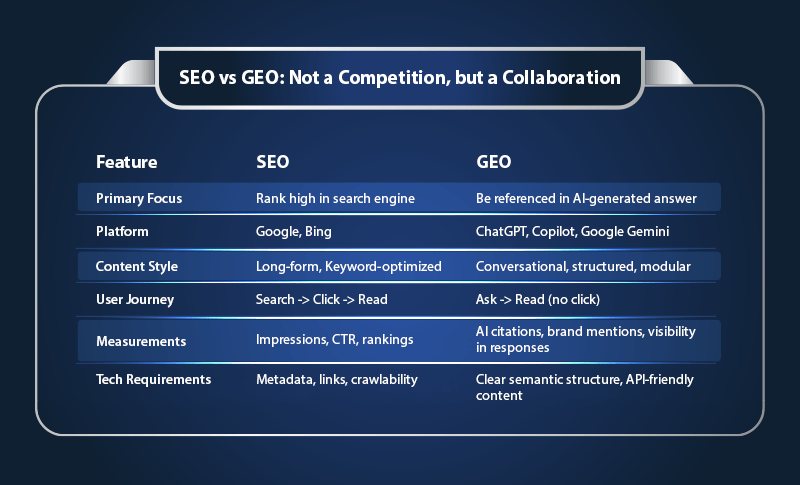
SEO vs GEO: Not a Competition, but a Collaboration
Let’s be clear: SEO and GEO aren’t battling it out for supremacy. They serve different purposes in the digital journey, and they’re more powerful when used together.
Here’s a deeper look at how SEO and GEO stack up against each other:
Platform of Focus
- SEO is for conventional search engines such as Bing and Google. The aim is to get a position on the first page (preferably top 3).
- GEO, on the other hand, is targeting AI-powered engines such as ChatGPT, Google Gemini Microsoft Copilot, and other tools based on large language models (LLM). Such websites offer direct answers from indexed or referenced material, often without forcing users to click through to a website.
Goal and User Intent
- SEO is all about driving organic traffic by inviting users to click on your site's link from a series of search results.
- GEO is more about being the provider of AI content. The goal is to structure and present information in a way that LLMs can retrieve, read, and display as a conversational answer even if the user never visits your site.
Content Structure and Format
- SEO content strategy is founded on long blog entries, search engine optimized meta tags, keywording, and internal linking schemes. Rich snippets and structured data (schema.org) are also necessary for visibility.
- GEO requires conversational, contextual, and modular content, organized in bite-sized chunks (FAQs, bullet points, how-to guides) that can be readily understood by generative engines and translated into natural language responses. This is fully compatible with headless CMS platforms such as Sitecore, Contentstack and Contentful, which enable flexible, structured content delivery.
Search Behavior and Experience
- In SEO, people perform a search, browse several results, and select which link to click - participating in an exploratory behavior.
- In GEO, people tend to get immediate, condensed answers right in the interface (e.g., ChatGPT or Google Gemini), minimizing link clicking and presenting the challenge of zero-click searches. Your content must be the answer.
Longevity and Adaptability
- SEO strategies are often reactive - adjusting to ever-changing Google algorithms.
- GEO is inherently proactive - it prepares content to be machine-readable, repurposable, and context-aware. In the long term, this positions your brand as a trusted source within generative ecosystems.

Final Thought
Both SEO and GEO operate in parallel but distinct channels of content consumption. SEO optimizes for visibility in search results, while GEO optimizes for inclusion in AI-generated conversations.
To remain competitive in this dual search world, brands must design content experiences that cater not only to users who search and click - but also to AI engines that read, interpret, and respond.
Connect with Espire to learn how SEO and GEO combined can help your business unravel unparalleled digital and content experiences.