Espire’s Content Bridge AI: Empowering SEO & GEO for the AI-Driven Future
The way people discover content is changing fast. Traditional search engines still matter, but more users are now turning to AI platforms like ChatGPT, Gemini, and Google’s AI experiences to ask questions and get direct answers. That shift is changing what digital visibility means for businesses. It is no longer enough for content to simply rank well. It also needs to be clear, trustworthy, well-structured, and easy for AI systems to understand and reference.
This is where the combined power of SEO and GEO becomes important. SEO continues to help businesses improve discoverability, accessibility, and domain authority, while GEO focuses on making content more likely to appear in AI-generated responses and summaries. Together, they create a stronger foundation for visibility in an increasingly AI-driven search landscape.
Note on terminology: Here, GEO refers to Generative Engine Optimization, optimizing content so it can be accurately understood, selected, and referenced in AI-generated answers (for example, AI summaries and conversational responses). This is different from “geo” in the geographic/local SEO sense.

Is SEO Still Relevant in the GEO Era?
Yes. Even as GEO becomes more important in AI-led discovery, SEO remains the foundation. Your content still needs to be discoverable, accessible, fast, and technically sound before search engines or AI systems that rely on search/retrieval signals can find and use it.
SEO also strengthens trust signals such as crawlable site structure, clear internal linking, topical relevance, and earned authority (for example, reputable mentions and backlinks). Those signals help your content get indexed and treated as credible, inputs that GEO can then build on to improve the likelihood your content is used in AI answers.
In practice, businesses do not need to choose between SEO and GEO: use SEO to ensure your content can be found and trusted, and use GEO to make it easy for AI systems to interpret, summarize, and reference accurately.
Are GEO Challenges Different from SEO Challenges?
Yes, but only to an extent. GEO introduces a new layer of complexity, yet many of its challenges are closely connected to the foundations of SEO. The biggest difference is that SEO focuses on helping content get found in search results, while GEO focuses on helping content get understood, trusted, and used in AI-generated answers. So, while the environment has changed, the underlying content problems often remain similar.
Creating Clear and Context-Rich Content
One of the main GEO challenges is that content now needs to be far more direct, structured, and context-rich. In SEO, businesses could sometimes still perform well with content that was keyword-optimized but not always deeply helpful. In GEO, that becomes harder. AI platforms are more likely to rely on content that clearly answers questions, explains concepts well, and provides enough context to be interpreted correctly. This makes clarity and usefulness much more important.
Maintaining Content Consistency
Another challenge is consistency. In SEO, fragmented content, duplicate messaging, and weak site structure could already hurt visibility. In GEO, those same issues can create disconnected brand experiences across AI platforms. If your content is not aligned, different AI systems may surface different interpretations of your brand, making the user experience less consistent and less reliable.
Building Trust and Authority
Trust is also a shared challenge, but GEO raises expectations further. SEO has always relied on authority signals such as backlinks, relevance, and domain strength. GEO builds on that by asking a deeper question: is this content credible enough to be referenced in an AI-generated response? That is why factual accuracy, authenticity, strong messaging, and content quality matter even more.
Evolving Beyond Traditional Search Thinking
So, GEO challenges are not completely different from SEO challenges. They are more like the next stage of them. SEO helps build the foundation for discoverability, while GEO pushes businesses to strengthen clarity, trust, structure, and consistency so their content can perform well in an AI-first search environment.
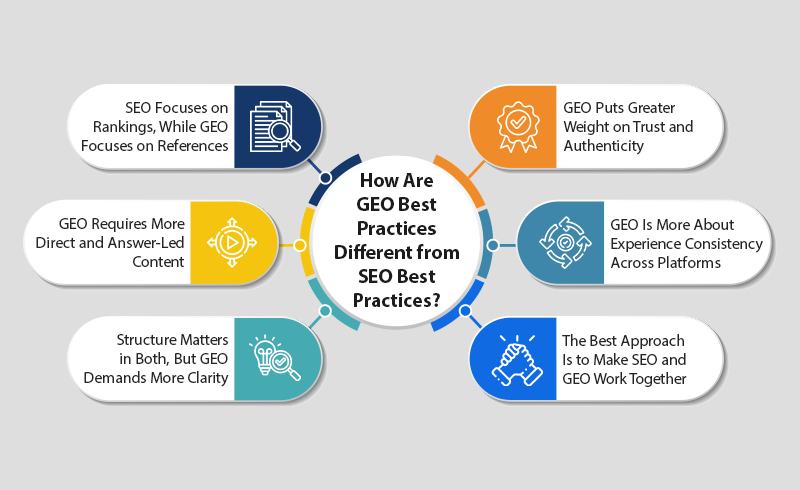
How Are GEO Best Practices Different from SEO Best Practices?
SEO and GEO are closely connected, but they are not the same. SEO is built around helping content rank well in search engines, while GEO is focused on helping content get understood, trusted, and referenced in AI-generated answers. That means the best practices overlap in some areas, but GEO requires a more answer-driven, context-rich, and human-centered approach.
SEO Focuses on Rankings, While GEO Focuses on References
Traditional SEO is largely about improving visibility in search engine results pages. It looks at factors such as keywords, backlinks, metadata, technical structure, and page authority. GEO, on the other hand, is less about where your page ranks and more about whether your content is strong enough to be picked up and used by AI platforms when users ask questions. In simple terms, SEO helps you get found, while GEO helps you get cited.
GEO Requires More Direct and Answer-Led Content
In SEO, content can sometimes perform well by covering a topic broadly and targeting the right keywords. GEO raises the expectation. Content needs to answer questions clearly, directly, and in a way that AI systems can easily interpret. This means businesses need to create content that is more concise, context-rich, and naturally aligned with how real users ask questions on AI platforms.
Structure Matters in Both, But GEO Demands More Clarity
SEO has always valued strong structure through headings, internal links, metadata, and crawlable pages. GEO also depends on structure, but with a greater emphasis on clarity and meaning. AI systems need content that is logically organized, easy to parse, and semantically clear. It is not enough for a page to be optimized for search engines. It also needs to be written in a way that helps AI understand what the content is saying and why it is useful.
GEO Puts Greater Weight on Trust and Authenticity
SEO has long relied on authority signals such as backlinks, domain strength, and relevance. GEO builds on those signals, but it also places more importance on whether the content feels credible, authentic, and genuinely helpful. AI platforms are more likely to surface content that reflects expertise, clear brand voice, trustworthy information, and strong topical relevance. This is why originality and authenticity matter even more in GEO.
GEO Is More About Experience Consistency Across Platforms
SEO mainly focuses on improving visibility within search engines. GEO extends that thinking across multiple AI-driven platforms where users may ask the same question in different places. As a result, GEO best practices must also consider how to create content that supports a more consistent brand experience across ChatGPT, Gemini, Google AI Overviews, and similar platforms. The goal is not just discoverability, but a more connected and reliable presence wherever users seek answers.
The Best Approach Is to Make SEO and GEO Work Together
The real difference is not that GEO replaces SEO. It is that GEO builds on SEO and takes content optimization further. SEO still lays the groundwork by making content discoverable and authoritative. GEO adds the next layer by making that content more usable, reference-worthy, and effective in AI-led discovery. Businesses that combine both will be in a much stronger position for the future of search.
Practical Checklist: GEO + SEO Readiness
- Answer first: Start key sections with a direct answer, then add supporting detail and nuance.
- Define terms: Include short definitions, assumptions, and “what this means” explanations for unfamiliar concepts.
- Structure for scanning: Use descriptive headings, short paragraphs, and lists where appropriate.
- Strengthen credibility: Add author/source signals (expertise, citations, dates, versioning) and avoid unsupported claims.
- Remove conflicts: Prevent duplicate or contradictory pages across sites and repositories; align messaging and naming.
- Make content extractable: Use consistent terminology, clear entities (product, audience, locations), and explicit relationships.
- Keep it fresh: Review and update priority pages on a defined cadence.
- Technical hygiene: Ensure crawlability, performance, canonicalization, and clean internal linking so content is reliably discoverable.
Suggested Metrics to Track
- SEO fundamentals: index coverage, crawl errors, Core Web Vitals, organic clicks/impressions, non-branded vs branded traffic.
- Content quality: content freshness, duplication rate, broken/outdated pages, readability/structure checks.
- Authority: quality mentions/backlinks, share of voice for priority topics.
- Generative visibility (GEO): AI referral traffic (where available), frequency of brand/product mentions for target queries, internal testing of “is our content referenced” across major AI experiences, and citation accuracy (are key facts quoted correctly).
Example outcomes (what “good” can look like): Fewer duplicate pages competing for the same intent, clearer FAQ-style answers on priority topics, more consistent product and policy language across channels, and fewer instances where AI outputs contradict your official messaging.
Below is a closer look at Espire’s AI-powered, plug-and-play solution and how it supports both SEO performance and GEO readiness.

How Content Bridge AI Supports SEO and GEO Optimization?
Espire’s Content Bridge AI helps businesses strengthen both SEO and GEO by turning fragmented content into a more structured, consistent, and discoverable digital asset. In many organizations, important content is spread across legacy CMS platforms, websites, documents, and disconnected repositories. This makes it difficult to optimize, manage, and reuse effectively. Content Bridge AI solves this challenge by intelligently extracting, organizing, mapping, and publishing content in a way that supports both traditional search visibility and AI-led discovery.
Content Bridge AI Working at a Glance
- Ingest: Pull content from sites, CMS platforms, documents, and repositories.
- Classify and normalize: Identify content types, extract key fields, and standardize formatting and terminology.
- Deduplicate and align: Detect overlaps and inconsistencies; align messaging and approved language.
- Map to a content model: Organize content into structured components (for example, product, feature, benefits, FAQs, policies).
- Validate and govern: Apply checks for completeness, accuracy, and publishing rules.
- Publish and monitor: Push structured content to target destinations and track changes over time.
Typical Outputs You Can Expect
- Cleaner, consolidated pages (fewer duplicates and conflicting versions).
- Structured content components that can be reused across channels (web pages, help centers, landing pages).
- More consistent headings and page layouts for better scanning and extraction.
- Improved readiness for structured markup and knowledge-like representations (where applicable).
From an SEO perspective, this creates a stronger content foundation. Well-structured and properly organized content is easier for search engines to crawl, index, and understand. It improves accessibility, supports better site hygiene, and helps businesses maintain consistency across pages and platforms. All of this contributes to stronger discoverability and better long-term search performance.
From a GEO perspective, the value goes further. AI experiences often combine retrieval signals with language understanding, so they tend to favor content that is clear, context-rich, internally consistent, and easy to extract into answers. Content Bridge AI helps move content in that direction by improving structure, reducing duplication, and aligning information to consistent content models so key facts are easier to interpret and reuse.
Consistency is another advantage. When content is scattered across systems and formats, brands risk publishing multiple versions of the same message. By standardizing content before publishing, Content Bridge AI helps teams maintain a more uniform experience whether users arrive via search results or AI-generated answers.
It also supports quality control through validation and governed workflows (for example, required fields, approval steps, and checks that reduce incomplete or inconsistent publishing). That matters for SEO because quality and clarity influence indexability and relevance, and it matters for GEO because accuracy and consistency influence whether AI systems treat your content as reliable.
Conclusion
Key Takeaways
- SEO is still the baseline: it helps content get discovered, crawled, and trusted.
- GEO extends visibility into AI answers: it prioritizes clarity, consistency, and reference-worthy information.
- Structure + governance scale both: consolidating, standardizing, and validating content improves performance across search and AI experiences.
As AI-led search continues to reshape how people discover information, businesses need content that does more than rank. It needs to be clear, credible, well-structured, and ready to be understood across AI platforms. That is exactly why GEO matters. It helps brands create content that is more likely to be trusted, referenced, and surfaced in AI-generated responses.
With Espire’s Content Bridge AI, businesses can take a stronger step in that direction by making content more structured, consistent, and experience-ready for the generative search era.
Want to explore how Content Bridge AI can help your business build more connected and AI-ready content experiences? Connect with Espire’s experts to start the conversation.