AI Hallucination: A Guide to Navigate Around Consistent Inconsistencies
Artificial Intelligence or AI has become “The talk of the of the town” today. As every business organization is either implementing the new technology to its environment, or it is developing solutions that are based on the technology. A new leap that has propelled the AI into mainstream businesses is the arrival of “Generative Pre-trained Transformer” (GPT), especially, ChatGPT by OpenAI. The Large Language Model (LLM) enables the users to ask questions, in human language and gets result in desired format.
However, as advanced it may sound, but the technology faces some glitches. Inconsistencies, where the GPT platform, provides false information believing that it’s right, known as “Hallucinations” in AI world.
So, as we now know what these hallucinations are, let’s look at types of these hallucinations, reasons behind them, and how can they be avoided while using AI.

AI Hallucinations: Understanding the Term
Typically, AI hallucinations refer to outputs generated by AI models that swerve from reality or lack facts.
In other words, when hallucinating, the AI model generates incorrect answers, fabricates a story, provides a result that is far from making any sense. The severity of the hallucinations can range from some mi or factual mistakes to an entirely fabricated or false story.
Often, the hallucinations are associated with text-based LLMs, however, they can also occur in image and video generators, resulting in contextually inaccurate outputs.
Exploring the Types of AI Hallucination
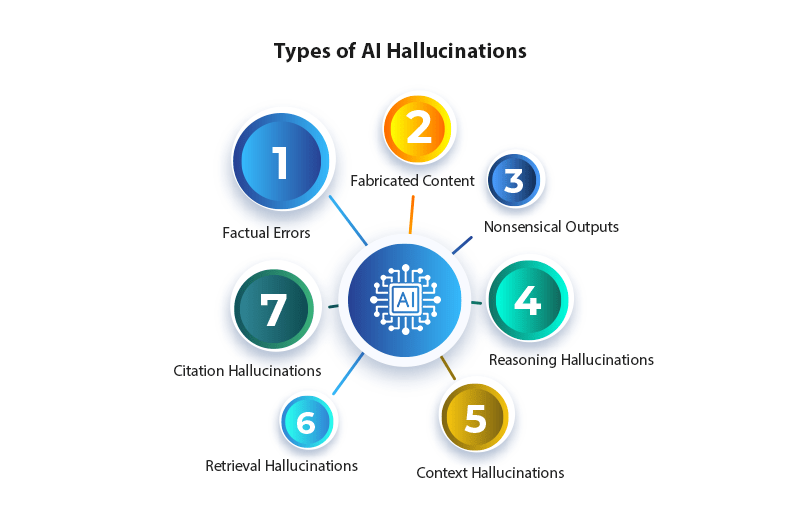
The hallucinations are generally categorized into three categories, namely:
- Factual Errors
- Fabricated Content
- Nonsensical Outputs
- Reasoning Hallucinations
- Context Hallucinations
- Retrieval Hallucinations
- Citation Hallucinations
These categories are not mutually exclusive, i.e. a single hallucination can often come under multiple categories. For example, a fabricated output can also be considered as factual error and it can also contain nonsensical elements.
Let’s explore these categories in detail with relevant examples.
Factual Error
These types of hallucinations occur when an AI model outputs incorrect information including scientific inaccuracies or historical falsehoods. This can be clearly explained in an multi-step logical query where the AI may begin correctly by identifying the right formula or initial assumption. But midway through the reasoning, it might miscalculate a value, mix up two related concepts, or apply a rule incorrectly.
Even though each step sounds logical and well-structured, that single flawed step can derail the entire chain of reasoning, resulting in a final answer that appears polished but is completely wrong.
Legacy models often stumbled upon such queries, while modern models, instead of all the improvements, frequently experience problems with complex questions, especially those involving uncommon numbers, scenarios, or multi-step logics that are not properly represented in its training data.
Note: The above is a typical example multi-step logics in legacy model of the GPT. However, has been improved in recent AI models.
Fabricated Content
This type of AI hallucination generally occurs when the AI model is unable to find relevant information in its pre-trained data. As a result, it fabricates a completely fictional story that supports the false response. The more obscure or less familiar the topic, the higher the likelihood of the model fabricating content.
Another challenge, especially for older models, arises when combining two facts, even if the model “knows” both, as demonstrated in the next example.
Nonsensical Outputs
Sometimes, the AI-generated outputs may appear polished and grammatically flawless while though being short of true coherence, especially when the prompt contains multiple contradicting information.
Such error typically occurs when the LLM are designed to predict next tokens, follow statistical patterns, and predict the placements of the words in their training data rather than truly understanding the meaning of the content they produce.
Since now we understand types of AI Hallucination, let’s understand what causes the new technology developed to mimic human responses, mimic human errors.
Reasoning Hallucinations (Chain-of-Thought Drift)
Sometimes an AI starts reasoning correctly but slowly loses the plot. Each step may sound logical on its own, yet one small mistake along the way throws off the final answer. Because the explanation feels confident and well-structured, the error is easy to miss.
For example, an AI solving a multi-step problem may walk through the logic smoothly but still land on the wrong conclusion because one assumption was flawed.
Context Hallucinations (Context Window Overflow)
AI models can only “remember” a limited amount of information at once. When conversations or inputs get too long, important details from earlier parts may drop out. When that happens, the AI may contradict itself or respond as if certain instructions were never given.
For instance, in a long discussion about system requirements, the AI might forget an earlier constraint and suggest something that directly conflicts with it.
Retrieval Hallucinations (Incorrect Grounding Usage)
When AI pulls information from external sources, it sometimes retrieves the wrong data, or misuses the right data. The result is an answer that sounds factual but is based on outdated, irrelevant, or misunderstood information.
An example would be an AI referencing an old regulation or policy and presenting it as current and valid.
Citation Hallucinations (Fabricated References)
In an attempt to sound credible, AI may create references that don’t actually exist. These citations often look legitimate, complete with author names and publication titles, but fall apart when checked.
For example, the AI might quote a research paper or journal article that cannot be found anywhere, despite appearing authentic.
The Root Causes of AI Hallucinations
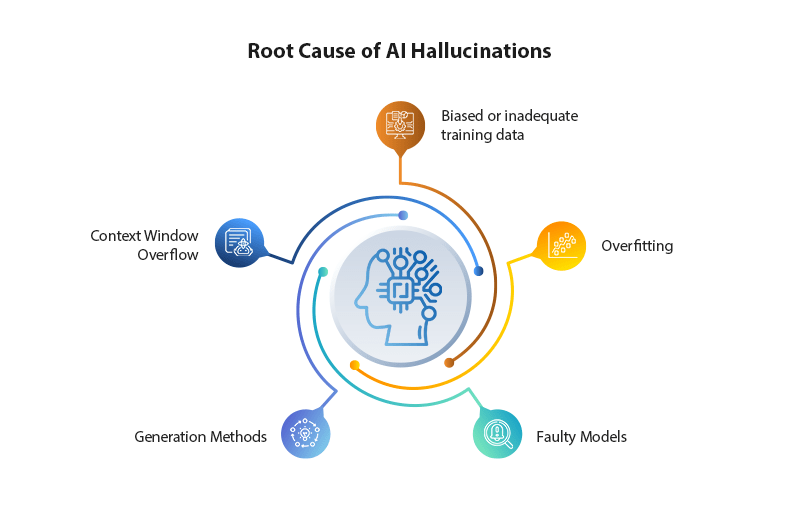
Generally, there are four key factors that forces AI models to hallucinate. They are:
- Biased or inadequate training data
- Overfitting
- Faulty Models
- Generation Methods
- Context Window Overflow
Let’s deep dive into each factor and understand the causes in detail.
Biased or Inadequate Training Data
Inadequate or biased training data is one of the primary reasons that leads to AI hallucinations. As we know that LLM models learn from massive datasets fed to them during model training. So, when the information they’re subjected to is incomplete, especially in niche or highly specialized fields, the LLMs start filling the gaps on their own, often with inaccurate details.
Usually, when a topic is covered by only limited sources, the LLMs may just memorize the information from that bundle of content rather than developing new understanding. Consequently, leading to unreliable answers. On the other hand, biased data make things even worse. If the dataset leans too heavily toward certain viewpoints or leaves out others entirely, the AI will naturally echo those skewed perspectives.
Overfitting
Overfitted models struggle to adapt because they’ve learned their training data too literally. Instead of understanding patterns, they end up memorizing them, which hurts performance when they face new or differently worded prompts.
Since people can ask the same question in countless ways, an overfitted model often can’t interpret these variations. It may cling to familiar phrasing from its training data and repeat it even when it doesn’t fit, leading to irrelevant or incorrect answers. This problem is even more common in niche topics where limited high-quality data forces the model to overfit in the first place.
Faulty Models
AI hallucinations aren’t simply caused by weak model design, they’re largely inherent to how modern LLMs work. These models generate text by predicting the next token based on probabilities, not by checking facts or truly “understanding” content.
Modern GPT-style models don’t use beam search in normal generation. Instead, they rely on top-p (nucleus) sampling and temperature controls to produce fluent, natural responses. While this improves readability and creativity, it also means the model can generate information that sounds right but isn’t actually correct.
Even with advances like model-guided tool calling, hallucinations can still occur if tools return incomplete or misinterpreted data. Ultimately, hallucinations are a byproduct of probabilistic generation and reducing them requires strong grounding and verification, not just better architecture.
Generation Methods
Hallucinations can also arise from the way modern LLMs generate text. Instead of older methods like beam search, today’s models rely on probabilistic sampling, which focuses on producing fluent language rather than guaranteed facts.
Techniques like, top-k, and top-p (nucleus) sampling introduce controlled randomness to make responses sound natural and varied. But when a model is unsure, these same methods can push it toward plausible-sounding but incorrect answers.
Even with model-guided tool calling, hallucinations occur when the model doesn’t retrieve the right information and falls back on pure prediction. Because the system is optimized for coherence over accuracy, sampling strategies can unintentionally amplify hallucinated outputs.
Context Window Overflow
AI models can only process a limited amount of information at one time. When prompts, documents, or conversations exceed this context window, earlier details may be dropped or misunderstood. As a result, the model may lose critical instructions, forget constraints, or misinterpret prior information leading to inaccurate or inconsistent responses.
This issue is especially common in long-form content generation, extended conversations, or complex technical discussions, where maintaining continuity and accuracy across multiple inputs is essential.
How to Prevent AI Hallucination
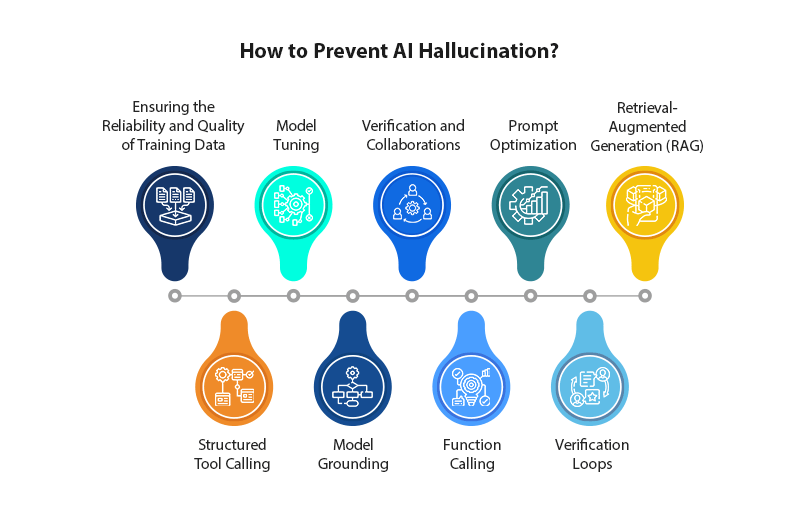
We have now explored What AI Hallucinations are, What are the types of hallucinations that an LLM can generate, and what are the reasons behind these hallucinations. Now let’s have a walkthrough over the strategies that can help you mitigate the risks of AI Hallucinations.
Ensuring the Reliability and Quality of Training Data
High-quality training data is one of the strongest defenses against AI hallucinations. When datasets are diverse, accurate, and balanced, models are far less likely to produce misleading or incorrect answers. A well-rounded dataset exposes the model to different contexts, languages, and cultural nuances, helping it respond more reliably.
To make this possible, deployers need strong data-curation practices such as, removing unreliable sources, updating data regularly, and adding expert-verified content. Methods like data augmentation and active learning can fill knowledge gaps, while bias-detection tools help ensure the final dataset is fair and representative.
Model Tuning
Fine-tuning and refining AI models play a key role in reducing hallucinations and improving accuracy. By tailoring a general model to specific tasks, developers can make responses more relevant, consistent, and aligned with real user needs.
Tools like Reinforcement Learning from Human Feedback (RLHF) help models learn directly from human input, guiding them toward better, more reliable behavior. Parameter adjustments can also shape how the model responds, making it more cautious for factual tasks or more creative for open-ended ones. Techniques such as dropout, regularization, and early stopping prevent overfitting, ensuring the model learns patterns instead of just memorizing data.
Verification and Collaborations
Checking AI outputs against trusted sources is a simple but powerful way to prevent hallucinations. Human reviewers can catch mistakes, correct misleading details, and avoid harmful outcomes.
Built-in fact-checking tools, like web-based verification systems, also help by comparing AI responses with reliable information in real time. This makes them especially valuable in fields where accuracy matters, such as education, research, or technical work.
For high-stakes areas like healthcare or law, adding human review provides an essential extra layer of safety and accountability.
Prompt Optimization
For end users, clear and well-structured prompts can significantly reduce AI hallucinations. Vague questions often lead to confused or inaccurate answers, while specific prompts give the model a clearer direction.
Simple prompt-engineering techniques can improve reliability, such as breaking a complex query into smaller steps so the AI can process it more accurately.
Retrieval-Augmented Generation (RAG)
Retrieval-Augmented Generation or RAG in an AI framework that reduces hallucinations by grounding AI responses in verified external data sources. Instead of relying only on its training knowledge, the model retrieves relevant information from trusted documents or databases at the time of the query. This ensures responses are based on real, up-to-date facts rather than assumptions.
Structured Tool Calling
Structured tool calling allows the AI to use predefined tools such as databases, calculators, or APIs in a controlled way. By separating reasoning from execution, the model is less likely to guess or fabricate information, especially in tasks that require precision.
Model Grounding
Model grounding ensures that AI outputs stay anchored to specific data sources, rules, or constraints. Whether it’s a policy document, a knowledge base, or enterprise data, grounding limits the model’s tendency to “fill gaps” with plausible but incorrect information.
Function Calling
Function calling enables the model to trigger specific functions instead of generating free-form text. This is particularly useful for workflows, data lookups, or structured outputs, where accuracy matters more than creativity. It helps ensure responses follow predictable and reliable patterns.
Verification Loops
Verification loops add an extra layer of safety by checking AI-generated outputs before final delivery. This can include cross-checking facts, validating sources, or re-prompting the model to review its own answers. These loops are especially important in high-risk domains like healthcare, finance, or legal services.
Conclusion: Building Trustworthy AI Starts with Awareness
AI hallucinations may never disappear entirely, but understanding how they happen, and what we can do to prevent them is the first step toward building safer, more reliable AI systems. By recognizing the different types of hallucinations, identifying the underlying causes, and applying practical mitigation techniques, businesses and developers can significantly improve the accuracy and trustworthiness of their AI models.
As AI continues to become a core part of digital transformation, the need for responsible, well-grounded systems has never been greater. Whether you’re deploying AI for customer support, analytics, automation, or content generation, the right strategy can help you unlock its full potential, without the risks of misleading or incorrect outputs.
If you’re looking to build AI solutions that are accurate, secure, and aligned with your business goals, our experts at Espire are here to help. Connect with us today to create AI experiences you can trust.